ChatGPT Plus Free Trial Guide: What Still Works After the 2025 Student Offer
A current, source-backed guide to ChatGPT Plus free trials. Learn which official routes are real, why the student help page still conflicts with the public URL, and when Go at $8 in the U.S. is enough versus paying $20 for Plus.
Nano Banana Pro
4K图像官方2折Google Gemini 3 Pro Image · AI图像生成
已服务 10万+ 开发者
ChatGPT Plus Free Trial Guide: What Still Works After the 2025 Student Offer
If you are searching ChatGPT Plus free trial, the hard part is no longer finding one more list of “methods.” The hard part is figuring out which official OpenAI route is real, which one is selective, which one only looks actionable because an older help page is still up, and whether paying $20/month for Plus instead of $8/month for Go in the U.S. is buying real certainty or just buying around one disputed doc row.
Right now the official answer is split across the promo FAQ, the lingering U.S./Canada student discount article, the public chatgpt.com/students page, the Go help page, the pricing matrix, the GPT-5.3 and GPT-5.4 in ChatGPT article, the Codex plan article, the credits FAQ, the Business Free help page, and OpenAI’s Go launch post(OpenAI Help Center: ChatGPT Promotional Subscriptions/Free Trial Invites FAQ; Student discounts for ChatGPT Plus (US/Canada); ChatGPT for students; OpenAI Help Center: What is ChatGPT Go?; ChatGPT Pricing; OpenAI Help Center: GPT-5.3 and GPT-5.4 in ChatGPT; OpenAI Help Center: Using Codex with your ChatGPT plan; OpenAI Help Center: Using Credits for Flexible Usage in ChatGPT (Free/Go/Plus/Pro) & Sora; OpenAI Help Center: ChatGPT Business Free; OpenAI: Introducing ChatGPT Go, now available worldwide,2026-03-19). This guide pulls those surfaces into one decision path so you can stop chasing a vague “trial” and decide whether to wait for a promo, claim a role-based route, stay on Free, buy Go, pay for Plus, or ignore Business entirely.
TL;DR
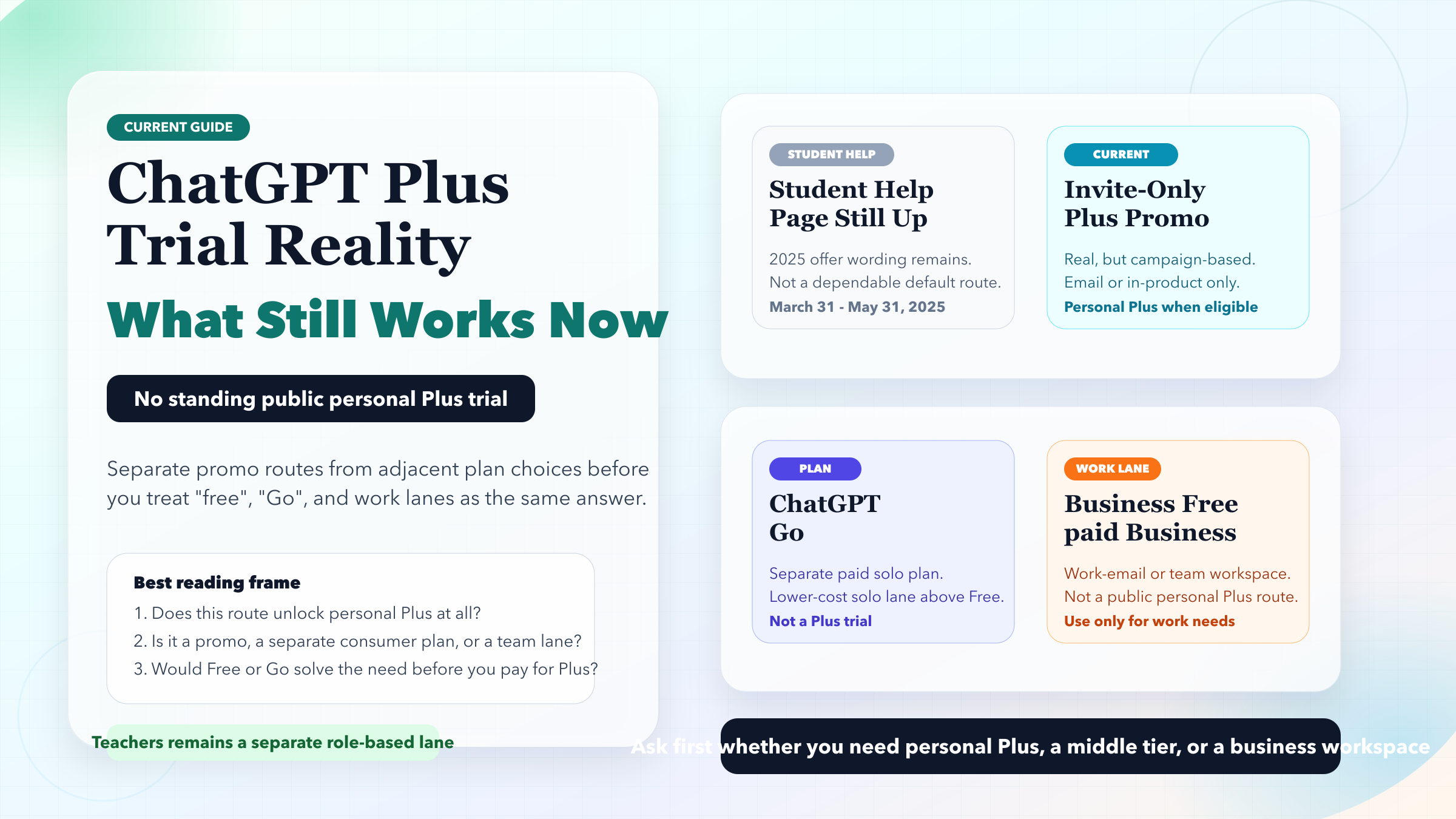
- There is still no standing public personal ChatGPT Plus trial page. The clean official free-trial answer remains selective promos, not an evergreen public checkout button(OpenAI Help Center: ChatGPT Promotional Subscriptions/Free Trial Invites FAQ,2026-03-19).
- The U.S./Canada student help article is still unusually explicit: it still describes a two-month Plus offer from March 31, 2025 through May 31, 2025, still tells users to go to
chatgpt.com/students, and still documents redemption support. But the publicchatgpt.com/studentsURL now redirects to the generalChatGPT for studentsuse-cases page atchatgpt.com/use-cases/students, whose first screen is a100 chats for college studentsprompt gallery rather than an obvious live offer landing page. Treat that route as explicit help-center residue, not as a dependable public default path(OpenAI Help Center: Student discounts for ChatGPT Plus (US/Canada); ChatGPT for students,2026-03-19). - Real official no-cost or trial-like routes still exist, but they are narrow: invite-based promos, the Australia/Colombia student referral program, ChatGPT for Teachers, and the veterans offer(OpenAI Help Center: ChatGPT Promotional Subscriptions/Free Trial Invites FAQ; Student Plus referral program (Australia/Colombia); OpenAI Help Center: ChatGPT for Teachers; OpenAI Help Center: ChatGPT Plus for Servicemembers & Veterans - Terms of Service,2026-03-19).
- Plus still costs
$20/month, while Go is currently$8/monthin the United States. More importantly, the current Plus help page now defines Plus around higherGPT-5.3limits plus access to advanced reasoning models, so the upgrade question isis that stable advanced lane worth $12/month more for my use case?, not an abstract “premium” step(OpenAI Help Center: What is ChatGPT Plus?; OpenAI: Introducing ChatGPT Go, now available worldwide,2026-03-19). - The safest current reading is not “one newer page settles everything.” Pricing is still the broad entitlement matrix, but some questions now need a more exact split between pricing rows, the Go help page, the
GPT-5.3 and GPT-5.4 in ChatGPTarticle, the Codex plan page, and the credits FAQ(ChatGPT Pricing; OpenAI Help Center: What is ChatGPT Go?; OpenAI Help Center: GPT-5.3 and GPT-5.4 in ChatGPT; OpenAI Help Center: Using Codex with your ChatGPT plan; OpenAI Help Center: Using Credits for Flexible Usage in ChatGPT (Free/Go/Plus/Pro) & Sora,2026-03-19). - Go is no longer a simple “no advanced features” lane, but it is not the same thing as the paid-tier
GPT-5.4 Thinkingrow either. The Go help page says Reasoning is included, and theGPT-5.3 and GPT-5.4 in ChatGPTpage says Go users can enable Thinking from the tools menu and send up to10Thinking messages every5 hours, while pricing still showsGPT-5.4 Thinking: Nofor Go. The safest interpretation is limited tool-menu Thinking on Go, not the same paid-tier Thinking entitlement Plus gets(OpenAI Help Center: What is ChatGPT Go?; OpenAI Help Center: GPT-5.3 and GPT-5.4 in ChatGPT; ChatGPT Pricing,2026-03-19). - The harder Go conflict is now narrower than many guides admit. Pricing explicitly gives Go
Data analysis: Yes,Projects: Yes,Create & share GPTs: Yes,Apps: Yes, andSora 2: Yes, but still showsTasks: No,Apps connecting to internal tools: No, andCodex: No. The Go help page, meanwhile, says Go includes projects, tasks, and custom GPTs, says select apps still require Plus, and still says Sora is not included. Use pricing as the safer checkout source when one exact row decides whether you should pay for Plus(ChatGPT Pricing; OpenAI Help Center: What is ChatGPT Go?,2026-03-19). - Do not buy Plus just for Sora. Pricing shows
Sora 2: Yeson Free, Go, and Plus, and the credits FAQ says Sora is supported for all users. The old Go help page still says no Sora, so that page looks lagging on this point(ChatGPT Pricing; OpenAI Help Center: Using Credits for Flexible Usage in ChatGPT (Free/Go/Plus/Pro) & Sora; OpenAI Help Center: What is ChatGPT Go?,2026-03-19). - Do not read Codex as a simple
yes on Free/Goorno on Free/Goanswer either. The latest Codex help page now explicitly separates stable paid Codex lanesPlus / Pro / Business / Enterprise-Edufrom the limited-time Free and Go inclusion, and it also says paid plans currently enjoy2xCodex rate limits. Pricing still showsCodex: Nofor Free/Go, and the credits FAQ still limits Codex credits to Plus/Pro. Buy Plus when you need the stable personal paid Codex lane, the higher paid-plan Codex ceiling, or Codex credits, not because Codex is impossible outside Plus(OpenAI Help Center: Using Codex with your ChatGPT plan; ChatGPT Pricing; OpenAI Help Center: Using Credits for Flexible Usage in ChatGPT (Free/Go/Plus/Pro) & Sora,2026-03-19). - Business Free and
Try for freeon the Business card are work-lane surfaces, not evidence of a personal Plus trial(OpenAI Help Center: ChatGPT Business Free; ChatGPT Pricing,2026-03-19).
Is there a real ChatGPT Plus free trial right now?
Not in the evergreen, public, “anyone can click and start today” sense. The clean first-party answer is still that free trials exist only through selective promotions or limited eligibility routes, not through a standing public personal Plus offer page(OpenAI Help Center: ChatGPT Promotional Subscriptions/Free Trial Invites FAQ,2026-03-19).
The student route is the main reason this search still feels confusing. OpenAI’s U.S./Canada student help article remains much more explicit than a stale archive page normally would be: it still gives a SheerID flow, still tells students to visit chatgpt.com/students, still says they should return there after verification, and still documents what to do if they were charged $20 by mistake(OpenAI Help Center: Student discounts for ChatGPT Plus (US/Canada),2026-03-19). But the public chatgpt.com/students URL currently redirects to the general ChatGPT for students use-cases page at chatgpt.com/use-cases/students, whose current first screen is a 100 chats for college students gallery rather than an obvious live offer landing page(ChatGPT for students,2026-03-19).
That is why the most accurate answer is not “yes” or “no” in isolation. The help-center redemption instructions still exist, so the route is not imaginary. But the public landing behavior does not act like a dependable broad public offer. If you do not actually see the offer surface in verification or in your account, do not plan around it as your main route.
The other real official routes are narrower and clearer. Invite-based promos are real when OpenAI surfaces them. The Australia/Colombia student referral program is school-specific. Teachers and veterans have their own dedicated official routes. Those are better treated as role-based or eligibility-based access paths, not as proof that a public consumer trial is available to everyone(OpenAI Help Center: ChatGPT Promotional Subscriptions/Free Trial Invites FAQ; Student Plus referral program (Australia/Colombia); OpenAI Help Center: ChatGPT for Teachers; OpenAI Help Center: ChatGPT Plus for Servicemembers & Veterans - Terms of Service,2026-03-19).
The legitimate ways to get free or discounted access
The official answer is now a route map, not a single offer. Some lanes are real personal Plus promos, some are role-based exceptions, some are simply adjacent consumer plans, and some are workspace products that should never be mistaken for personal Plus.
Use this decoder first:
| Route | What it really is | Best fit | What not to assume |
|---|---|---|---|
| Invite-based promo | Selective personal Plus trial or promo surfaced by OpenAI | People who actually receive an email or in-product invite | Do not assume every account or country has one |
| U.S./Canada student help article | A still-explicit help-center redemption path tied to the 2025 student offer | Students checking whether the old flow still resolves for their account | Do not treat the help article alone as proof of a dependable public landing page |
| Australia/Colombia student referral | Limited school-based Plus route | Eligible students at listed schools | Do not generalize it into a global student offer |
| ChatGPT for Teachers | Free educator-specific access route | Verified U.S. K-12 educators | Do not call it a standing consumer Plus trial |
| Veterans offer | 1 free year of Plus for eligible U.S. servicemembers and recent veterans | Qualified servicemembers or veterans | Do not treat it as open to the general public |
| ChatGPT Free | The real no-cost evaluation lane | Light testing and casual use | Do not assume “free” means irrelevant |
| ChatGPT Go | Separate lower-cost consumer plan above Free | Solo users who need more room but not the full stable Plus lane | Do not call it a Plus trial |
| ChatGPT Business Free | No-cost work workspace for eligible work emails in Australia and Japan | People evaluating ChatGPT at work | Do not treat it as personal Plus |
| Paid ChatGPT Business | Paid collaborative workspace | Teams and work buyers | Do not confuse Business CTAs with personal access |
The student lane deserves one extra warning because it can fool careful readers, not just careless ones. The help article still reads like a route you should be able to claim, but the public URL no longer behaves like a clean public checkout page when opened today(OpenAI Help Center: Student discounts for ChatGPT Plus (US/Canada); ChatGPT for students,2026-03-19). That is exactly the kind of conflict this article needs to solve.
The Business lane deserves the same discipline for a different reason. OpenAI’s Business card still says Try for free, and the Business Free help page still documents a no-cost work workspace in Australia and Japan, but both belong to the work lane. Neither is evidence that personal ChatGPT Plus is free(ChatGPT Pricing; OpenAI Help Center: ChatGPT Business Free,2026-03-19).
What ChatGPT Free, Go, and Plus actually unlock
The consumer-plan story is now broader than Free vs Plus. OpenAI’s live pages describe a middle ground where Go is clearly more than Free, but still less settled than Plus when one exact feature becomes the entire buying reason(ChatGPT Pricing; OpenAI Help Center: What is ChatGPT Go?; OpenAI Help Center: GPT-5.3 and GPT-5.4 in ChatGPT,2026-03-19).
The current official split is sharper than a simple Go yes / Plus yes chart. Pricing explicitly gives Go Data analysis: Yes, Projects: Yes, Create & share GPTs: Yes, Apps: Yes, and Sora 2: Yes, while still showing GPT-5.4 Thinking: No, Tasks: No, Apps connecting to internal tools: No, and Codex: No for Go(ChatGPT Pricing,2026-03-19). The Go help page is useful but broader: it says Go includes projects, tasks, and custom GPTs, says Reasoning is included through the + menu, says select apps still require Plus or higher, and still says Sora is not included(OpenAI Help Center: What is ChatGPT Go?,2026-03-19). The GPT-5.3 and GPT-5.4 in ChatGPT page adds the exact Thinking rule: Go users can enable Thinking from the tools menu and send up to 10 messages every 5 hours, while paid tiers get the model picker for manual GPT-5.4 Thinking selection(OpenAI Help Center: GPT-5.3 and GPT-5.4 in ChatGPT,2026-03-19).
That does not make Go equal to Plus. The safer interpretation is that Go now clearly includes more day-to-day capability than many listicles admit, but the remaining disputes matter exactly where people overspend: manual GPT-5.4 Thinking, Tasks, apps that connect to internal tools, stable Codex entitlement, and the exact Sora boundary. That is why Go is a meaningful middle lane, but Plus remains the stable advanced personal lane you choose when one exact capability needs to be dependable rather than interpreted across conflicting docs(ChatGPT Pricing; OpenAI Help Center: What is ChatGPT Plus?; OpenAI Help Center: What is ChatGPT Go?; OpenAI Help Center: GPT-5.3 and GPT-5.4 in ChatGPT,2026-03-19).
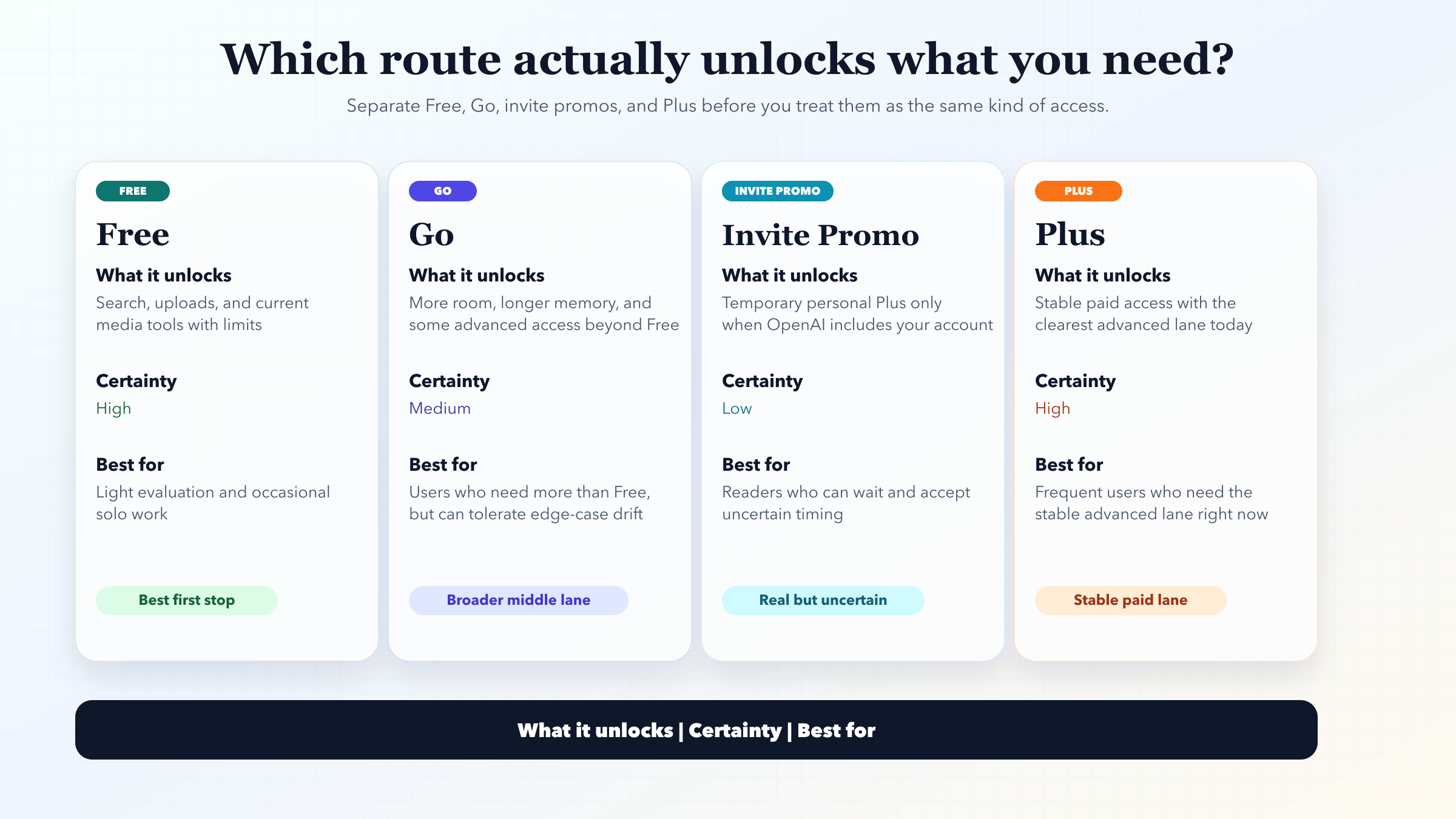
Use the current consumer-lane reading below as the practical version:
| Plan or route | Safe current interpretation | Best for | Do not buy it for |
|---|---|---|---|
| Free | Real evaluation tier with limited flagship access and current Sora 2 availability | Testing workflows before paying | Heavy repeated use or assumption that it mirrors Plus |
| Go | Broader middle lane above Free with real Yes rows on data analysis, projects, GPT creation, apps, and Sora 2, but still live conflicts around Tasks, Codex, Sora wording, and paid-tier Thinking | Solo users who want more room without jumping straight to Plus | A purchase where one exact disputed boundary decides the plan |
| Invite promo | Temporary personal Plus when OpenAI explicitly surfaces it | Readers who actually receive an offer | A route you can reliably plan around |
| Plus | Stable paid personal lane with clearer advanced access and fewer “does this still count?” questions | Frequent users who need dependable advanced access now | Team workspace needs that belong to Business |
Three reader mistakes now matter more than the old Free vs Plus question. The first is buying Plus just for Sora. Pricing and the credits FAQ both put Sora in front of all users today, so Sora is no longer a strong default reason to step from Free or Go to Plus(ChatGPT Pricing; OpenAI Help Center: Using Credits for Flexible Usage in ChatGPT (Free/Go/Plus/Pro) & Sora,2026-03-19). The second is reading Codex as a simple yes-or-no plan row when the latest Codex help page now splits the answer into two layers: stable paid Codex lanes on Plus / Pro / Business / Enterprise-Edu, limited-time inclusion on Free and Go, and current 2x Codex rate limits on the paid lanes, while pricing and the credits FAQ answer different parts of the same purchase question(OpenAI Help Center: Using Codex with your ChatGPT plan; ChatGPT Pricing; OpenAI Help Center: Using Credits for Flexible Usage in ChatGPT (Free/Go/Plus/Pro) & Sora,2026-03-19). The third is paying Plus to solve what might only be a limited Go-vs-Pricing disagreement, especially around Thinking, Tasks, Codex, or the exact Sora wording, before checking whether you truly need the paid-tier entitlement or only a narrower Go path(OpenAI Help Center: What is ChatGPT Go?; OpenAI Help Center: GPT-5.3 and GPT-5.4 in ChatGPT; ChatGPT Pricing,2026-03-19).
Which official page should you trust when OpenAI pages conflict?
This is the part most competing pages still miss. The reader does not just need current facts. The reader needs a rule for deciding which official fact should control the decision they are about to make.
The safest current rule is question-based, not page-based. Use the narrowest and freshest official page that directly governs the exact question you are asking. Pricing is still the best broad matrix. But when the question is about one capability, one eligibility flow, or one temporary entitlement, a newer feature-specific or route-specific page can beat the broader matrix.
Use this source-priority matrix:
| Question | Best official source to trust first | Why that source wins | Current exception to know | What to do |
|---|---|---|---|---|
| Is there a standing public personal Plus free trial? | ChatGPT Promotional Subscriptions/Free Trial Invites FAQ | It is the clean first-party page for trial legitimacy | It covers selective promos, not a public checkout page | Stop searching for a universal public Plus trial page |
| Does the student route still matter? | Student discounts for ChatGPT Plus (US/Canada) plus the live behavior of chatgpt.com/students | The help article still gives redemption steps, but the public route shows whether there is a dependable landing surface | The help page remains explicit even though the public URL redirects to the general chatgpt.com/use-cases/students page | Only keep chasing it if the offer actually surfaces in verification or in your account |
| How should I compare the broad plan ladder? | ChatGPT Pricing | It is still the clearest structured matrix for Free, Go, Plus, Pro, and Business | Broad matrices can still conflict with plan FAQs on Go rows like Tasks, Codex, or Sora | Use pricing for high-level plan shopping, then verify any disputed row with the narrower feature page before buying |
| Should I trust the Go help page on tasks, apps, or Sora wording? | ChatGPT Pricing first, then the dedicated capability page if one exists | Pricing is still the safest checkout matrix for exact entitlement rows | The Go FAQ is broader orientation copy: it says projects, tasks, and custom GPTs are included, says select apps still require Plus, and still says no Sora; pricing is more granular and currently shows Go yes for Apps, Projects, Create & share GPTs, Data analysis, and Sora 2, but no for Tasks and Apps connecting to internal tools | Use pricing for the exact row that decides your purchase, then use the narrower capability page for the feature-specific nuance |
| Does Go have Thinking access? | What is ChatGPT Go? plus GPT-5.3 and GPT-5.4 in ChatGPT | Both current pages directly govern Go’s tool-menu Reasoning / Thinking behavior | Pricing still shows GPT-5.4 Thinking: No for Go | Treat Go as having limited tool-menu Thinking, not the same paid-tier model-picker GPT-5.4 Thinking entitlement Plus gets |
| Should I buy Plus just for Sora? | ChatGPT Pricing plus Using Credits for Flexible Usage in ChatGPT (Free/Go/Plus/Pro) & Sora | Both current pages place Sora across users and clarify limits | The Go help page still says no Sora, which now looks stale | Do not buy Plus for Sora 2 alone; buy higher only for higher limits or specific Sora variants |
| Should I buy Plus just for Codex? | Using Codex with your ChatGPT plan plus the credits FAQ | One page governs current access, while the other governs who can buy extra Codex credits | Pricing still shows Codex: No for Free/Go even though the Codex page now splits stable paid access from limited-time Free/Go inclusion and says paid plans currently get 2x Codex rate limits | Check Codex access first; choose Plus when you need the stable personal paid lane, the higher paid-plan Codex ceiling, or Codex credits, not because Codex is totally unavailable elsewhere |
| Is Business Free a personal trial? | ChatGPT Business Free | It directly defines the work-lane product | Pricing also shows Try for free on Business, which can mislead readers | Ignore Business wording if your real need is personal Plus |
The practical point is simple. When the question is about whether a trial exists, trust the trial or eligibility page. When the question is about the broad plan ladder, trust pricing. When the question is about Go Thinking, use the current Go help page and GPT-5.3 and GPT-5.4 in ChatGPT together, then interpret them against pricing rather than pretending the pricing row vanished. When the question is about one exact capability like Sora or Codex, use the dedicated current capability page plus pricing as the context layer rather than the only answer(ChatGPT Pricing; OpenAI Help Center: What is ChatGPT Go?; OpenAI Help Center: GPT-5.3 and GPT-5.4 in ChatGPT; OpenAI Help Center: Using Codex with your ChatGPT plan; OpenAI Help Center: Using Credits for Flexible Usage in ChatGPT (Free/Go/Plus/Pro) & Sora,2026-03-19).
How to avoid fake ChatGPT Plus free-trial offers
This query still attracts low-trust pages because the official answer is fragmented and the keyword has commercial intent. That makes source discipline more important than ever.
The safest filter is narrow. Trust routes that OpenAI documents on its own pricing, help, or official product pages. Distrust pages that need unsupported extras like mobile-only “secret” trials, retention offers, coupon bundles, or third-party workarounds to make the answer feel bigger than the first-party evidence actually supports(OpenAI Help Center: ChatGPT Promotional Subscriptions/Free Trial Invites FAQ; ChatGPT Pricing,2026-03-19).
The easiest scam tell is still the same: real promo details come from OpenAI email or from inside ChatGPT. Legitimate first-party pages explain who is eligible, whether a payment method is required, whether the offer auto-renews, and whether the route is personal Plus or a different lane entirely(OpenAI Help Center: ChatGPT Promotional Subscriptions/Free Trial Invites FAQ,2026-03-19). If a page cannot show that level of official specificity, do not let it become your proof.
One more practical filter matters now. If a page cites one official OpenAI source but ignores another current one that changes the answer, the page may still be using real sources and still be functionally outdated. That is exactly what happens when a guide cites pricing but ignores the current Go help page, GPT-5.3 and GPT-5.4 in ChatGPT, the Codex plan page, or the credits FAQ. Current source coverage matters as much as source brand.
When paying for Plus is the better decision
If you qualify for a role-based or school-based route, claim that first. Teachers, eligible veterans, and the Australia/Colombia student-referral users all have stronger official no-cost paths than “maybe a public Plus trial exists somewhere”(OpenAI Help Center: ChatGPT for Teachers; OpenAI Help Center: ChatGPT Plus for Servicemembers & Veterans - Terms of Service; Student Plus referral program (Australia/Colombia),2026-03-19).
If you do not qualify for those routes, the right paid choice now depends less on marketing labels and more on what kind of certainty you need. Free is still the cleanest place to evaluate. Go is the better middle step when you want more everyday room and can tolerate some feature-specific nuance. Plus is the better paid answer when you need the stable advanced personal lane and do not want your decision to depend on temporary or conflicting exceptions. That is also how OpenAI now describes it: the current Plus page frames Plus around higher GPT-5.3 limits plus advanced reasoning models, not just around a generic premium badge. Business is for workspaces, not for solo personal trial-seekers(ChatGPT Pricing; OpenAI Help Center: What is ChatGPT Plus?; OpenAI Help Center: What is ChatGPT Go?; OpenAI Help Center: ChatGPT Business Free,2026-03-19).
In the United States, Go is currently $8/month and Plus is $20/month, so moving from Go to Plus is a $12/month decision, not a vague “premium upgrade” gesture(OpenAI: Introducing ChatGPT Go, now available worldwide; OpenAI Help Center: What is ChatGPT Plus?,2026-03-19). That should force a more exact question: are you paying for stable advanced access that you know you need, or are you paying to escape one row that current official docs still describe inconsistently?
Use this scenario matrix as the shortest version:
| If your situation looks like this | Best route | Why |
|---|---|---|
| You qualify for Teachers, Veterans, or the listed Australia/Colombia student referral program | Claim that official route first | A real eligibility-based path beats waiting for a generic promo |
| You are still hoping the old U.S./Canada student help page means there is a dependable public trial | Do not plan around it unless the offer actually surfaces for you | The help article is explicit, but the public landing route is not dependable today and currently resolves to a general student use-cases page(OpenAI Help Center: Student discounts for ChatGPT Plus (US/Canada); ChatGPT for students,2026-03-19) |
| You mainly want to test current ChatGPT workflows before paying | Stay on Free | It is the lowest-risk evaluation lane and already covers more than many outdated guides admit |
| You need more solo headroom than Free and can live with some feature-specific nuance | Choose Go | It is the broader middle lane and, in the U.S., the cheaper paid test at $8/month before jumping to Plus(OpenAI: Introducing ChatGPT Go, now available worldwide,2026-03-19) |
The only reason you would pay $12/month more than Go for Plus is one disputed row such as Tasks, apps connecting to internal tools, Codex, or the exact shape of Thinking access | Re-check pricing and the exact capability page before checkout | Paying the full Plus premium to resolve one ambiguous row is a bad default unless that row is your real blocking need(ChatGPT Pricing; OpenAI Help Center: What is ChatGPT Go?; OpenAI Help Center: GPT-5.3 and GPT-5.4 in ChatGPT; OpenAI Help Center: Using Codex with your ChatGPT plan; OpenAI Help Center: Using Credits for Flexible Usage in ChatGPT (Free/Go/Plus/Pro) & Sora; OpenAI: Introducing ChatGPT Go, now available worldwide,2026-03-19) |
| You need stable paid personal access and do not want your purchase to depend on a limited or conflicting exception | Pay for Plus | Plus is the safer advanced personal lane when exact capability certainty matters |
| Codex is the only reason you are thinking about paying | Check the Codex plan page, pricing, and the credits FAQ first, then decide between Free, Go, Plus, and Business | Free/Go may include Codex for a limited time, but Plus is the safer personal paid lane if you need stable access, the higher paid-plan Codex ceiling, or Codex credits(OpenAI Help Center: Using Codex with your ChatGPT plan; ChatGPT Pricing; OpenAI Help Center: Using Credits for Flexible Usage in ChatGPT (Free/Go/Plus/Pro) & Sora,2026-03-19) |
| Sora is the only reason you are thinking about paying | Do not buy Plus for that reason alone | Current official pages already place Sora 2 across users; pay more only for higher limits or more specialized variants(ChatGPT Pricing; OpenAI Help Center: Using Credits for Flexible Usage in ChatGPT (Free/Go/Plus/Pro) & Sora,2026-03-19) |
| You actually need shared projects, company routing, admin controls, or a work-ready space | Use Business Free or paid Business | That is a work-lane decision, not a personal Plus question(OpenAI Help Center: ChatGPT Business Free; ChatGPT Pricing,2026-03-19) |
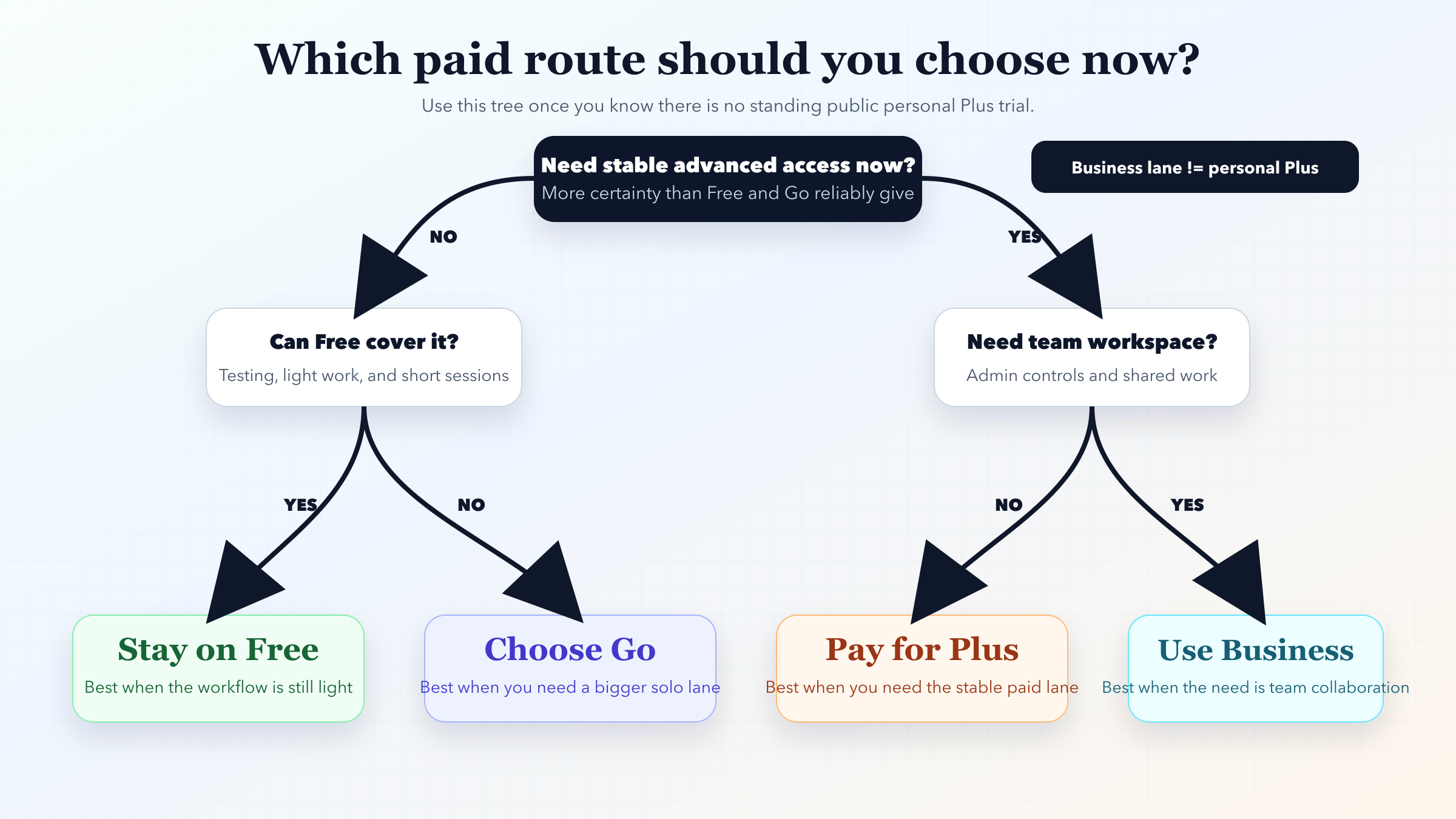
There is one important nuance under that table. Pay for Plus does not mean Plus is the only place where advanced-looking features ever appear. It means Plus is the safer answer when the extra $12/month buys stability rather than guesswork for a personal account, and the current Plus help page now makes that promise explicit through higher GPT-5.3 limits plus advanced reasoning models. If your checkout decision depends on the paid-tier GPT-5.4 Thinking row, that broader Plus definition, the stable personal paid Codex lane, the current paid-plan 2x Codex rate-limit ceiling, Codex credits, or broad pricing rows that still stay out of Go, Plus is the cleaner lane today. If you are only trying to verify whether a narrower current Go path is already good enough, re-check or test first before paying more(ChatGPT Pricing; OpenAI Help Center: What is ChatGPT Plus?; OpenAI Help Center: GPT-5.3 and GPT-5.4 in ChatGPT; OpenAI Help Center: Using Codex with your ChatGPT plan; OpenAI Help Center: Using Credits for Flexible Usage in ChatGPT (Free/Go/Plus/Pro) & Sora; OpenAI: Introducing ChatGPT Go, now available worldwide,2026-03-19).
If you need help with the paid side of that decision, our guide to how much ChatGPT Plus costs explains the pricing logic, our ChatGPT Go vs ChatGPT Plus comparison goes deeper on the middle-tier tradeoff, and our ChatGPT Plus cancellation guide covers what to do if you subscribe and later decide the value is not there.
FAQ
Is there a public ChatGPT Plus free trial page right now?
No dependable public personal Plus trial page is visible today. OpenAI’s current first-party trial wording is still about selective promotional subscriptions or role-based routes, not about a universal public checkout page(OpenAI Help Center: ChatGPT Promotional Subscriptions/Free Trial Invites FAQ,2026-03-19).
Is the 2025 ChatGPT Plus student offer still active?
Treat it as an explicit but non-dependable route. The U.S./Canada help article still describes the March 31, 2025 through May 31, 2025 offer, still points users to chatgpt.com/students, and still documents redemption support, but the public student URL currently redirects to the general ChatGPT for students use-cases page at chatgpt.com/use-cases/students instead of an obvious live offer landing page(OpenAI Help Center: Student discounts for ChatGPT Plus (US/Canada); ChatGPT for students,2026-03-19).
Are invite-based ChatGPT Plus free trials real?
Yes. OpenAI still says eligible users may receive or generate referral links or codes for free limited-duration trials, with details surfaced by email or within ChatGPT(OpenAI Help Center: ChatGPT Promotional Subscriptions/Free Trial Invites FAQ,2026-03-19). That makes them real, but still selective rather than universal.
Should I trust the pricing page, the Go help page, or the feature page when they conflict?
Trust the official page that directly governs the exact question, then interpret it against pricing if the plan ladder still matters. Use promo or eligibility pages for trial legitimacy, pricing for broad plan rows, the current Go help page plus GPT-5.3 and GPT-5.4 in ChatGPT for Go Thinking, and the Codex or credits pages for Codex and Sora edge cases(ChatGPT Pricing; OpenAI Help Center: What is ChatGPT Go?; OpenAI Help Center: GPT-5.3 and GPT-5.4 in ChatGPT; OpenAI Help Center: Using Codex with your ChatGPT plan; OpenAI Help Center: Using Credits for Flexible Usage in ChatGPT (Free/Go/Plus/Pro) & Sora,2026-03-19).
Is ChatGPT Go a free trial of Plus?
No. It is a separate paid consumer plan between Free and Plus. It now reaches farther than many older guides suggest, but it is still a distinct middle lane rather than a disguised Plus trial(OpenAI Help Center: What is ChatGPT Go?; ChatGPT Pricing,2026-03-19).
Does Go have any Thinking access now?
Yes, but not in the same way Plus does. The current Go help page says Reasoning is included through the + menu, and the GPT-5.3 and GPT-5.4 in ChatGPT page says Go users can send up to 10 Thinking messages every 5 hours after enabling Thinking from the tools menu(OpenAI Help Center: What is ChatGPT Go?; OpenAI Help Center: GPT-5.3 and GPT-5.4 in ChatGPT,2026-03-19). Pricing still shows GPT-5.4 Thinking: No for Go, so the safest interpretation is limited tool-menu Thinking on Go, not the same paid-tier GPT-5.4 Thinking entitlement Plus gets(ChatGPT Pricing,2026-03-19).
Why do the Go docs still disagree on tasks, apps, or Sora?
Because those answers now come from different official surfaces with different jobs, and they no longer line up cleanly on every row. The Go help page is the right source for Go’s Reasoning path and it is the page that says Go includes projects, tasks, and custom GPTs. Pricing, however, is more granular: it currently shows Go Apps: Yes, Projects: Yes, Create & share GPTs: Yes, Data analysis: Yes, and Sora 2: Yes, while still showing Tasks: No, Apps connecting to internal tools: No, Codex: No, and GPT-5.4 Thinking: No. For checkout-safe buying decisions, trust the exact pricing row first, then use the narrower capability page for the feature-specific nuance(OpenAI Help Center: What is ChatGPT Go?; ChatGPT Pricing; OpenAI Help Center: GPT-5.3 and GPT-5.4 in ChatGPT; OpenAI Help Center: Using Credits for Flexible Usage in ChatGPT (Free/Go/Plus/Pro) & Sora,2026-03-19).
Should I buy Plus just for Sora?
Not by default. Pricing currently shows Sora 2: Yes on Free, Go, and Plus, and the credits FAQ says Sora is supported for all users(ChatGPT Pricing; OpenAI Help Center: Using Credits for Flexible Usage in ChatGPT (Free/Go/Plus/Pro) & Sora,2026-03-19). Buy higher only if you specifically need higher limits or more specialized Sora variants.
Should I buy Plus just for Codex?
Not blindly. OpenAI’s latest Codex plan article now says stable paid Codex access lives on Plus / Pro / Business / Enterprise-Edu, while Free and Go only get Codex for a limited time, and those paid lanes currently enjoy 2x Codex rate limits; pricing still shows Codex: No for Free/Go, and the credits FAQ limits Codex credits to Plus/Pro(OpenAI Help Center: Using Codex with your ChatGPT plan; ChatGPT Pricing; OpenAI Help Center: Using Credits for Flexible Usage in ChatGPT (Free/Go/Plus/Pro) & Sora,2026-03-19). Buy Plus when you need the stable personal paid Codex lane, the higher paid-plan Codex ceiling, or Codex credits, not because Codex is impossible outside Plus.
Is ChatGPT Business Free the same as a ChatGPT Plus trial?
No. Business Free is a no-cost work workspace for eligible work emails in Australia and Japan. It belongs to the work lane, not to personal Plus(OpenAI Help Center: ChatGPT Business Free,2026-03-19).
Does ChatGPT for Teachers count as a Plus free trial?
Not really. It is better understood as a separate official access route for verified U.S. K-12 educators, free through June 2027, rather than as a standing public consumer trial(OpenAI Help Center: ChatGPT for Teachers,2026-03-19).
Is there an official ChatGPT Plus offer for veterans?
Yes. OpenAI says eligible U.S. servicemembers within their final 12 months of service and veterans within the past 12 months after separation can claim 1 free year of ChatGPT Plus(OpenAI Help Center: ChatGPT Plus for Servicemembers & Veterans - Terms of Service,2026-03-19).