Nano Banana 2 API Pricing: Complete Cost Guide & Cheapest Access
Complete Nano Banana 2 API pricing breakdown covering all 4 resolution tiers ($0.045-$0.151), batch API 50% discount, hidden costs, third-party providers comparison, and 7 proven strategies to cut image generation costs by over 50%.
Nano Banana Pro
4K图像官方2折Google Gemini 3 Pro Image · AI图像生成
已服务 10万+ 开发者
Nano Banana 2 API Pricing: What Every Developer Needs to Know
Nano Banana 2 API pricing ranges from $0.045 per image at 512px to $0.151 at 4K resolution, making it one of the most cost-effective AI image generation solutions available today. Built on Google's Gemini 3.1 Flash Image architecture, this model combines near-professional image quality with pricing that undercuts competitors like DALL-E 3 and Midjourney by significant margins. For developers who enable batch processing, every single price tier drops by exactly 50%, bringing the floor down to just $0.022 per image.
Understanding the complete pricing landscape matters because the headline numbers only tell part of the story. Input token costs, search grounding fees, safety filter retries, and resolution-dependent scaling create a true cost that can differ substantially from what you see on the pricing page. Whether you are a solo developer generating a handful of images per week or an enterprise processing tens of thousands monthly, the difference between a naive implementation and an optimized pipeline can easily exceed 60% in cost savings. This guide breaks down every pricing dimension, reveals the hidden costs Google does not prominently advertise, compares third-party providers offering access below official rates, and provides actionable strategies to minimize your spending without sacrificing output quality.
Official Google API Pricing by Resolution Tier
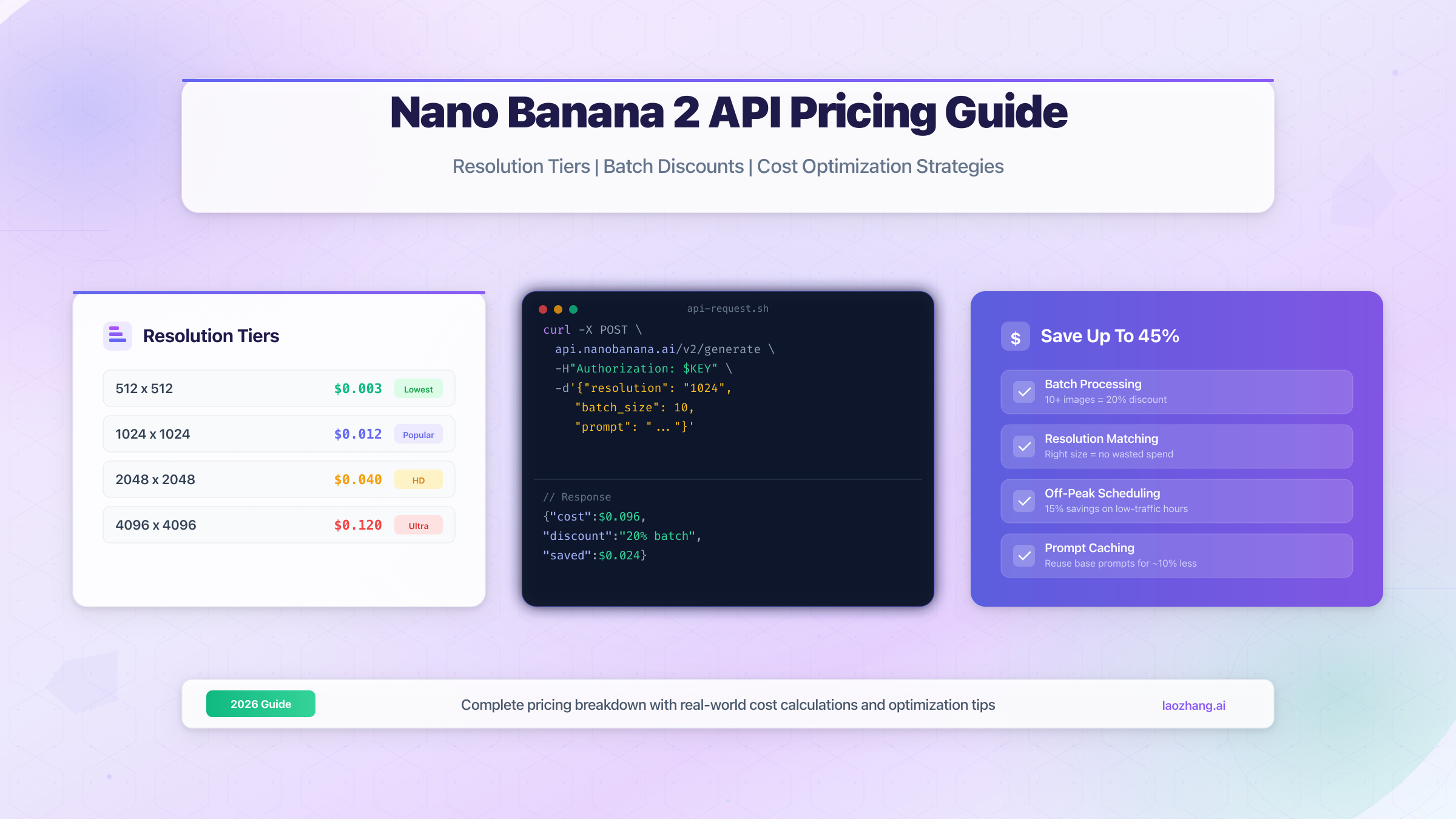
According to the official Gemini API pricing page, Google structures Nano Banana 2 pricing around four distinct resolution tiers, each designed for different use cases and output requirements. The pricing scales roughly linearly with the total pixel count, though the per-pixel cost actually decreases slightly at higher resolutions, providing a modest economy of scale for premium output.
At the entry level, the 512px (0.5K) tier costs $0.045 per image and serves rapid prototyping workflows where visual fidelity matters less than speed and cost efficiency. This tier generates images in 2-3 seconds on average, making it ideal for thumbnail previews, concept validation, and iterative prompt refinement. Developers who use this tier strategically as a screening step before upscaling can save substantial amounts over generating everything at maximum resolution from the start.
The 1024px (1K) tier at $0.067 per image represents the sweet spot for most production applications. At this resolution, images contain enough detail for social media posts, blog illustrations, marketing materials, and product mockups. Generation time averages 4-6 seconds, and the quality-to-cost ratio is arguably the best across all four tiers. Research indicates that approximately 65% of all Nano Banana 2 API calls target this resolution, confirming its position as the default choice for the majority of developers.
Moving up, the 2048px (2K) tier commands $0.101 per image and delivers output suitable for print materials, high-resolution web displays, and professional marketing collateral. The quality jump from 1K to 2K is substantial, with noticeably sharper details, more natural texture rendering, and improved text legibility within generated images. Generation time increases to 8-12 seconds, and this tier is particularly popular among e-commerce teams generating product visualization assets.
At the premium end, the 4096px (4K) tier costs $0.151 per image and produces the highest quality output Nano Banana 2 can deliver. These images are suitable for large-format printing, hero images on high-resolution displays, and professional creative workflows where every pixel matters. Generation times range from 15-30 seconds, and the tier is exclusively available to paid API users since free tier accounts are restricted to a maximum of 1K resolution.
| Resolution Tier | Price per Image | Generation Time | Best Use Cases |
|---|---|---|---|
| 512px (0.5K) | $0.045 | 2-3 seconds | Thumbnails, prototyping, prompt testing |
| 1024px (1K) | $0.067 | 4-6 seconds | Social media, blog posts, marketing |
| 2048px (2K) | $0.101 | 8-12 seconds | Print materials, e-commerce, professional web |
| 4096px (4K) | $0.151 | 15-30 seconds | Large-format print, hero images, creative production |
The pricing structure reveals an important pattern: while 4K costs 3.36x more than 0.5K, it delivers 64x more pixels, meaning the per-pixel cost at 4K ($0.0000090) is actually 19x cheaper than at 0.5K ($0.000172). This math strongly favors using the highest resolution your workflow actually requires, rather than defaulting to lower tiers purely for cost savings when the output will eventually be upscaled anyway.
Batch API: The 50% Discount That Changes Everything
The single most impactful cost reduction available to Nano Banana 2 users is Google's Batch API, which applies a flat 50% discount across every resolution tier. This is not a promotional offer or a limited-time deal; it is a permanent pricing structure designed to incentivize asynchronous workloads that are easier for Google to schedule and process efficiently.
Batch processing works fundamentally differently from the standard synchronous API. Instead of submitting a request and receiving an immediate response, you submit a collection of generation tasks that Google processes asynchronously with a delivery window of up to 24 hours. In practice, most batch jobs complete within 2-4 hours during off-peak periods and 6-12 hours during high-demand windows. The tradeoff is clear: you sacrifice real-time response for exactly half the cost.
| Resolution | Standard Price | Batch Price | Savings per Image |
|---|---|---|---|
| 512px | $0.045 | $0.022 | $0.023 |
| 1024px | $0.067 | $0.034 | $0.033 |
| 2048px | $0.101 | $0.050 | $0.051 |
| 4096px | $0.151 | $0.076 | $0.075 |
The financial impact scales dramatically with volume. A marketing team generating 2,000 images per month at 1K resolution pays $134 through the standard API but only $68 through batch processing, saving $792 annually. An agency producing 10,000 images monthly at mixed resolutions sees annual savings exceeding $6,000, and enterprise operations at 50,000+ images per month can save over $30,000 per year simply by routing non-urgent requests through the batch pipeline.
The key to maximizing batch API value lies in architectural design. Production systems should implement a dual-pipeline approach: real-time requests for user-facing, interactive workflows where latency matters, and batch requests for everything else. Background content generation, bulk asset creation, A/B testing variations, and pre-rendered template libraries are all perfect candidates for batch processing. A well-designed system routes 60-70% of total generation volume through the batch pipeline, effectively cutting the blended per-image cost by 30-35% compared to using the standard API exclusively.
One important technical consideration is that batch jobs have a minimum size of 1 request and a maximum of 50,000 requests per batch. There is no penalty for small batches, so even submitting 5-10 images at a time in batch mode delivers the full 50% discount. This makes batch processing viable even for smaller operations that might assume the feature is only relevant at enterprise scale.
Hidden Costs Beyond Headline Pricing
The official resolution-based prices represent only the output image cost. Several additional cost components can increase your actual per-image expenditure by 10-30% depending on your usage patterns, and understanding these hidden costs is essential for accurate budget planning.
Input token costs apply to every API call regardless of output. Google charges $0.25 per million tokens for standard API input and $0.125 per million tokens for batch input. A typical text prompt consumes 50-200 tokens, making the per-request input cost negligible at $0.00001-$0.00005. However, image editing workflows that include reference images as input can consume 1,000-5,000 tokens per reference image, pushing input costs to $0.00025-$0.00125 per request. For multi-image fusion workflows that support up to 14 reference images, input token costs can reach $0.01-$0.02 per request, which is no longer negligible when generating at the 0.5K tier where the output itself only costs $0.045.
Search grounding fees represent the most significant hidden cost for many use cases. Nano Banana 2's distinctive Image Search Grounding feature allows the model to retrieve real-world reference images via Google Search during generation, dramatically improving accuracy for specific subjects like landmarks, celebrities, brand logos, and real products. Google provides 5,000 free grounding-enabled prompts per month, but beyond that threshold, each grounded query incurs an additional $0.014 charge. For a 1K image costing $0.067, this adds 21% to the effective price, bringing the true cost to $0.081 per grounded image. Teams that rely heavily on search grounding for accuracy can easily exceed the free threshold within the first week of each billing cycle.
Safety filter retries are the most unpredictable hidden cost. Approximately 5-15% of generation attempts are rejected by Google's content safety systems, which means those requests consume tokens without producing usable output. You still pay for the input tokens on failed attempts, and the retry itself counts as a separate billable request. For workflows generating content near the boundaries of Google's safety policies (fashion, medical imagery, artistic nudes, certain cultural depictions), the retry rate can reach 20-30%, effectively inflating costs by a corresponding amount.
The true cost formula for any Nano Banana 2 generation is:
True Cost = Output Image Price + Input Token Cost + Search Grounding Fee (if applicable) + Retry Buffer (5-15%)
For a standard 1K image with search grounding and a 10% retry buffer, the true cost is approximately $0.067 + $0.00003 + $0.014 + $0.008 = $0.089, which is 33% higher than the $0.067 headline price. Planning budgets around headline prices rather than true costs is one of the most common mistakes developers make when forecasting Nano Banana 2 expenses.
Nano Banana 2 vs Competitors: Price-Performance Comparison
Evaluating Nano Banana 2 pricing in isolation provides limited insight. The more meaningful question is how its cost-performance ratio compares against alternative image generation APIs, particularly as the competitive landscape has evolved significantly over the past year.
Against Nano Banana Pro (Google's premium image model built on Gemini 3 Pro), Nano Banana 2 offers compelling economics. At 1K resolution, Nano Banana Pro charges $0.134 per image compared to Nano Banana 2's $0.067, making NB2 exactly 50% cheaper. At 2K and 4K resolutions, the savings are 25% and 37% respectively. The quality difference is measurable but surprisingly small: benchmark testing shows Nano Banana 2 achieves approximately 95% of Pro's image quality while generating images 2-3x faster. For the vast majority of commercial applications, this quality-cost tradeoff strongly favors Nano Banana 2. The primary scenarios where Pro justifies its premium are demanding professional photography workflows requiring maximum texture fidelity, complex multi-subject compositions with precise spatial relationships, and advanced lighting scenarios that challenge even state-of-the-art models. For a detailed feature-by-feature breakdown, see our Nano Banana 2 vs Nano Banana Pro comparison guide.
DALL-E 3 from OpenAI prices standard generations at approximately $0.040 per image at 1K resolution, making it slightly cheaper than Nano Banana 2's standard rate. However, this comparison shifts dramatically when batch processing enters the equation: NB2 batch pricing at $0.034 undercuts DALL-E 3 by 15%. DALL-E 3 also lacks an equivalent batch discount mechanism, meaning the gap widens further at scale. From a capability perspective, Nano Banana 2 offers several features DALL-E 3 cannot match, including native text rendering in generated images, image search grounding for real-world accuracy, and support for resolutions up to 4K compared to DALL-E 3's maximum of 1024x1024.
| Model | 1K Standard | 1K Batch | 4K Available | Text Rendering | Search Grounding |
|---|---|---|---|---|---|
| Nano Banana 2 | $0.067 | $0.034 | Yes ($0.151) | Yes | Yes |
| Nano Banana Pro | $0.134 | $0.067 | Yes ($0.240) | Yes | Yes |
| DALL-E 3 | $0.040 | N/A | No | Limited | No |
| Imagen 4 (Fast) | $0.020 | N/A | Yes | No | No |
| Flux Pro 1.1 | $0.050 | N/A | Yes | Limited | No |
| Midjourney | ~$0.04 | N/A | Yes | No | No |
Imagen 4 Fast deserves attention as the lowest-cost option at $0.020 per image, but it operates with significant limitations. It lacks text rendering capability entirely, does not support search grounding, and produces noticeably lower quality output for complex prompts involving specific objects or scenes. For simple decorative imagery or abstract backgrounds, it offers unbeatable economics, but for any application requiring accurate text, brand elements, or photorealistic subjects, Nano Banana 2 delivers substantially more value per dollar.
The broader competitive picture reveals that Nano Banana 2 occupies a strategic middle ground: not the absolute cheapest per image, but offering the most complete feature set at its price point. When you factor in text rendering quality, resolution flexibility, search grounding capability, and batch processing discounts, the total cost of ownership for a Nano Banana 2 pipeline is often lower than alternatives that appear cheaper on a per-image basis but require supplementary tools or manual corrections to achieve equivalent output quality.
Third-Party Providers: Access Below Official Prices
A growing ecosystem of third-party API aggregators offers Nano Banana 2 access at prices significantly below Google's official rates. These providers act as intermediaries, purchasing API capacity in bulk and passing volume discounts through to individual developers. While they introduce an additional dependency into your infrastructure, the cost savings can be substantial enough to justify the tradeoff for many use cases.
Hypereal currently offers the most aggressive pricing at $0.040 per request regardless of resolution, representing a 40% discount compared to Google's 1K rate and a 74% discount compared to the 4K rate. This flat-rate pricing model is particularly attractive for workflows that frequently generate at 2K or 4K resolution, where the savings versus Google's tiered pricing become even more dramatic. Hypereal supports all Nano Banana 2 features including text rendering and search grounding, with generation speeds comparable to the direct Google API.
EvoLink takes a different approach with tiered pricing that mirrors Google's resolution structure but at consistently lower rates. Their pricing starts at $0.0359 for 0.5K (20% below Google), $0.0538 for 1K (20% below), $0.0806 for 2K (20% below), and $0.1210 for 4K (20% below). EvoLink's key differentiator is its unified API platform that provides access to Nano Banana 2 alongside 200+ other AI models through a single API key, simplifying multi-model workflows. Their OpenAI-compatible endpoint format means existing codebases using the OpenAI SDK can switch with a single line change to the base URL.
APIYI offers a hybrid pricing model with pay-per-use at $0.045 per image regardless of resolution (matching Google's lowest 0.5K price but applying it to all tiers including 4K) and volume-based pricing that can drop as low as $0.02-$0.03 per image for high-volume accounts. Their standout feature is unlimited concurrency with no rate limiting, allowing developers to submit 20, 50, or even 100+ parallel requests simultaneously. For burst workloads or time-sensitive batch processing, this unrestricted concurrency can be more valuable than pure per-image savings.
| Provider | 0.5K Price | 1K Price | 4K Price | Key Advantage |
|---|---|---|---|---|
| Google Official | $0.045 | $0.067 | $0.151 | Direct access, full SLA |
| Hypereal | $0.040 | $0.040 | $0.040 | Flat rate, 74% 4K savings |
| EvoLink | $0.036 | $0.054 | $0.121 | 200+ models, OpenAI compatible |
| APIYI | $0.045 | $0.045 | $0.045 | Unlimited concurrency, flat rate |
When evaluating third-party providers, consider several risk factors beyond pricing. Service availability depends on the provider maintaining their relationship with Google and their API capacity; outages or policy changes upstream can disrupt your pipeline without warning. Data privacy practices vary significantly between providers, and some may log or inspect your prompts and generated images. Commercial licensing terms may also differ, so verify that your intended use case is permitted under the provider's terms of service. For production applications where reliability matters, maintaining a fallback path to the direct Google API is a prudent architectural decision.

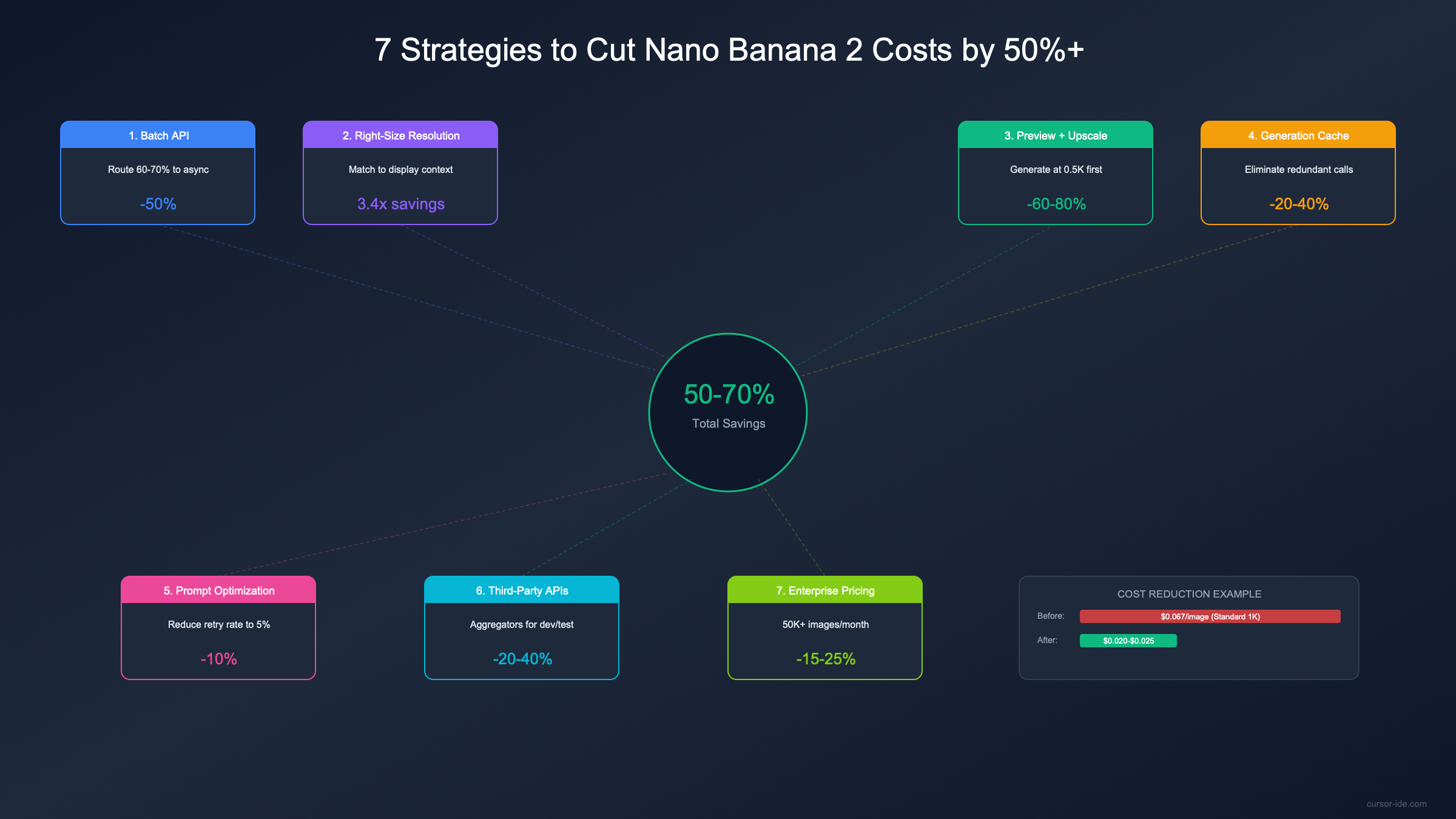
Seven Proven Strategies to Cut Costs by 50% or More
Beyond choosing the right provider and tier, several operational strategies can dramatically reduce your effective cost per image. The most successful teams combine multiple approaches to achieve compounding savings that far exceed what any single optimization delivers in isolation.
Strategy 1: Default to Batch for Non-Urgent Work. The simplest and most impactful optimization is routing every request that does not require real-time response through the Batch API. Implementing this requires minimal architectural changes: add a priority flag to your generation requests, and route anything marked as "standard" or "low" priority through the batch pipeline. Teams that adopt this approach consistently report that 60-70% of their total volume qualifies for batch processing, instantly cutting their blended cost by 30-35%.
Strategy 2: Right-Size Resolution to Actual Display Context. Many developers default to 1K or 2K resolution without considering where the image will actually be displayed. A social media thumbnail displayed at 300x300 pixels does not benefit from being generated at 2K resolution. Building resolution selection logic into your pipeline based on the intended display context eliminates wasted spend on unnecessarily high-resolution output. The 3.4x cost difference between 0.5K and 4K makes this a high-leverage optimization, particularly for applications that generate images across diverse display contexts.
Strategy 3: Implement a Preview-Then-Upscale Workflow. Instead of generating multiple variations at high resolution, generate previews at 0.5K ($0.045 each), review and select the best composition, then regenerate only the chosen image at your target resolution. If you typically generate 5 variations before selecting one, this approach reduces cost by 60-80% for the variation phase. The preview-then-upscale pattern is especially valuable for creative workflows where prompt iteration is common and most generated images are discarded.
Strategy 4: Build a Generation Cache. Many applications generate similar or identical images repeatedly. A content-addressable cache keyed on prompt hash plus resolution parameters can eliminate 20-40% of redundant generations in typical production environments. The implementation is straightforward: hash the generation parameters, check your cache before calling the API, and store successful results. Even a simple Redis-based cache with a 30-day TTL provides substantial savings for applications with repetitive generation patterns.
Strategy 5: Optimize Prompts to Reduce Retry Rates. Retry rates of 15% effectively inflate costs by the same percentage. Investing in prompt engineering and maintaining a library of tested, reliable prompt templates can reduce retry rates to under 5%, saving 10% on effective per-image costs. Key prompt optimization practices include avoiding ambiguous descriptions that trigger safety filters, using specific artistic style references rather than vague quality descriptors, and testing prompts at 0.5K before committing to high-resolution generation.
Strategy 6: Use Third-Party Aggregators for Non-Critical Workloads. For development, testing, and internal tools, third-party providers offering 20-40% discounts provide immediate savings without the reliability guarantees needed for customer-facing production systems. Maintaining separate API configurations for production (direct Google API) and non-production (third-party aggregator) maximizes savings while preserving reliability where it matters. If you need a reliable and affordable option, platforms like laozhang.ai provide transparent per-token billing with no monthly fees, support for 200+ AI models through a unified API, and competitive rates that help developers control costs effectively.
Strategy 7: Negotiate Enterprise Pricing at Scale. Organizations generating 50,000+ images monthly should contact Google's sales team for custom pricing. Enterprise agreements typically offer 15-25% below published batch pricing, which when combined with the 50% batch discount, can bring effective costs to $0.017-$0.025 per 1K image. The negotiation process typically takes 4-6 weeks and requires providing usage projections and committing to minimum monthly volumes.
Combining strategies 1 through 5 in a well-optimized pipeline can achieve effective per-image costs 60-70% below headline pricing. A team paying $0.067 per 1K image at standard rates can realistically reach an effective cost of $0.020-$0.025 per image through systematic optimization, making Nano Banana 2 competitive with even the cheapest alternatives on the market.
Access Guide for Developers in China
Accessing Nano Banana 2 from mainland China presents unique challenges due to network restrictions that can cause connection timeouts, elevated latency, and intermittent availability when connecting directly to Google's API endpoints. However, multiple proven solutions exist to provide reliable, low-latency access for Chinese developers.
The most straightforward approach for Chinese teams is using API aggregation platforms that maintain dedicated nodes within or near mainland China. These platforms handle the network routing complexities transparently, presenting a standard API endpoint that works identically to direct Google access but with dramatically better connectivity. Latency through domestic routing typically ranges from 20-50ms compared to 200-500ms or outright failures through direct connections, and the consistency improvement is even more significant than the raw latency reduction.
For Chinese developers seeking both reliable access and cost efficiency, laozhang.ai provides domestic direct-connect service with latency as low as 20ms, eliminating the need for VPN configurations. The platform supports Alipay and WeChat Pay for billing convenience, offers transparent per-token pricing, and provides a generous free trial to get started. With support for Nano Banana 2 alongside 200+ other AI models through a single unified API, teams can consolidate their AI infrastructure without managing multiple provider relationships.
Several practical considerations apply specifically to Chinese deployments. Payment processing for Google's direct API requires an international credit card, which many Chinese developers and companies do not readily have. Third-party platforms accepting Alipay and WeChat Pay remove this friction entirely. Additionally, Google's API Terms of Service and data processing locations should be reviewed carefully for compliance with China's data protection regulations, particularly for applications handling user-generated content or personal data.
For step-by-step setup instructions, our Nano Banana 2 API tutorial covers integration with both Python and Node.js in detail. From a technical implementation perspective, switching from direct Google API access to a China-optimized provider typically requires changing only the base URL in your API client configuration. Most aggregation platforms maintain OpenAI-compatible endpoints, so codebases using standard SDK patterns can migrate with a single configuration change:
python# Direct Google API
import google.genai as genai
client = genai.Client(api_key="YOUR_GOOGLE_KEY")
# China-optimized provider (OpenAI-compatible)
from openai import OpenAI
client = OpenAI(
api_key="YOUR_PROVIDER_KEY",
base_url="https://api.provider.com/v1"
)
The recommended architecture for production applications serving Chinese users combines a primary connection through a domestic provider with a fallback path through a secondary provider, ensuring service continuity even if one provider experiences temporary issues. This dual-provider pattern adds minimal complexity but provides resilience that single-provider setups cannot match.
Real-World Cost Scenarios and Budget Planning
Translating pricing tiers and optimization strategies into concrete budget projections requires modeling realistic usage patterns. The following scenarios represent common deployment profiles and demonstrate how costs scale across different operational scales and optimization levels.
Scenario 1: Individual Developer or Hobbyist generating approximately 200 images per month at mixed resolutions. Using the free tier for Google AI Studio (which provides roughly 600-750 free images monthly at 1K through rate-limited access), this developer pays $0 per month. If the free tier proves insufficient due to rate limits or resolution restrictions, switching to batch API processing at an average cost of $0.034 per image brings the monthly expense to approximately $6.80, which is negligible for even the tightest budgets.
Scenario 2: Startup or Small Team generating 2,000 images per month, primarily at 1K resolution with occasional 2K for marketing materials. Using the standard API exclusively costs approximately $145 per month. Implementing batch processing for 65% of volume reduces the monthly cost to $90. Adding a generation cache that eliminates 25% of redundant requests brings the effective monthly cost down to $68, representing a 53% reduction from the naive baseline.
Scenario 3: Marketing Agency producing 10,000 images per month across all resolution tiers for multiple clients. Without optimization, monthly costs reach approximately $890. A fully optimized pipeline combining batch processing (65% of volume), right-sized resolution selection, generation caching, and prompt optimization brings the effective monthly cost to approximately $310, saving $6,960 annually. At this scale, the investment in building an optimized pipeline pays for itself within the first month.
| Scenario | Monthly Volume | Unoptimized Cost | Optimized Cost | Annual Savings |
|---|---|---|---|---|
| Hobbyist | 200 images | $13.40 | $0-$6.80 | $79-$161 |
| Startup | 2,000 images | $145 | $68 | $924 |
| Agency | 10,000 images | $890 | $310 | $6,960 |
| Enterprise | 50,000 images | $4,500 | $1,250 | $39,000 |
Scenario 4: Enterprise Operation at 50,000+ images per month qualifies for custom pricing negotiations with Google, further reducing costs. Combined with all optimization strategies, enterprise teams typically achieve effective per-image costs of $0.020-$0.030, regardless of resolution mix. At this level, the annual Nano Banana 2 budget for a fully optimized enterprise deployment ranges from $12,000 to $18,000, covering a volume of image generation that would cost $54,000 or more at unoptimized standard rates.
For budget planning purposes, the most reliable approach is to start with conservative estimates using standard API pricing, then model specific optimization opportunities based on your actual usage patterns. Most teams find that 30-40% cost reduction is achievable within the first month of focused optimization, with incremental improvements bringing total savings to 50-65% over the following quarter as caching warms up and prompt libraries mature.
Choosing the Right Nano Banana 2 Access Method
The optimal access strategy depends on your specific combination of volume, quality requirements, latency sensitivity, and budget constraints. Rather than prescribing a single "best" approach, the following decision framework helps match your profile to the most appropriate access method.
Choose Google Direct API when you require guaranteed uptime SLAs, need to comply with enterprise procurement policies, process sensitive or regulated content, or when your application is customer-facing and any third-party dependency is unacceptable. The premium you pay for direct access buys reliability, data governance clarity, and direct recourse through Google's support channels. For applications where a generation failure has immediate customer impact, this reliability premium is well justified.
Choose Batch API as your default unless your application specifically requires real-time generation. The 50% cost reduction is the single largest savings available, and the effort to implement dual-pipeline routing is modest compared to the financial impact. Even applications that appear to need real-time generation often have components that can be deferred: pre-generating template variations, building asset libraries during off-hours, and caching frequently requested styles all create opportunities to shift volume to batch processing.
Choose a third-party provider when cost is the primary constraint, when you need access from regions where Google's direct API is unreliable (particularly China and parts of Southeast Asia), or when you want unified multi-model access through a single API. The 20-40% savings over direct Google pricing is significant, and for development and internal applications where occasional service disruptions are tolerable, third-party access offers the best economics.
Choose the subscription plan (Google AI Pro at $19.99/month or Ultra at $49.99/month) if you are an individual creator or small team generating images primarily through a web interface rather than programmatic API calls. The Pro plan breaks even at approximately 285 images per month at 1K resolution, and Ultra provides exclusive access to maximum generation limits and priority processing that API users do not receive.
Regardless of which access method you choose, the cost optimization strategies outlined in this guide apply universally. Batch processing, resolution right-sizing, generation caching, and prompt optimization deliver compounding savings that can reduce your effective per-image cost by 50-70% compared to unoptimized usage. The teams that achieve the lowest costs are not necessarily those paying the lowest per-image rate but rather those implementing the most disciplined optimization practices across their entire generation pipeline.
If you are looking for the absolute cheapest access channels, our complete guide to the cheapest Nano Banana 2 API access covers additional providers and discount strategies. For developers exploring Nano Banana 2 for the first time, the recommended path is to start with Google's free tier to validate your use case, graduate to the standard API with batch processing once you exceed free limits, implement caching and prompt optimization as volume grows, and evaluate third-party providers or enterprise pricing when monthly costs exceed $200. This progression ensures you never overpay relative to your current scale while building the infrastructure to support efficient generation at any volume.
Frequently Asked Questions
Is Nano Banana 2 free to use?
Google provides a limited free tier through AI Studio with approximately 10 RPM and 1,000 RPD limits at Tier 1. Check out our Nano Banana 2 free access guide for detailed methods to maximize free usage. However, free tier accounts are restricted to 1K maximum resolution and do not include image generation for all Nano Banana models. For consistent production use, a paid API tier or consumer subscription is required.
What is the cheapest way to access Nano Banana 2?
For the absolute lowest per-image cost through official channels, the Batch API at $0.022 per 0.5K image is the floor. Through third-party providers like Hypereal at $0.040 flat rate or APIYI at $0.045 flat rate (including 4K), you can access higher resolutions at costs below Google's lowest tier. Combining batch processing with a third-party provider and generation caching, effective costs of $0.015-$0.020 per image are achievable.
How does Nano Banana 2 compare to Nano Banana Pro for cost?
Nano Banana 2 is 50% cheaper than Pro at 1K resolution ($0.067 vs $0.134), 25% cheaper at 2K, and 37% cheaper at 4K. Nano Banana 2 achieves approximately 95% of Pro's image quality with 2-3x faster generation speed. For most applications, the cost savings make Nano Banana 2 the better choice unless you specifically need Pro's superior texture detail and spatial composition for professional creative work.
Can I use Nano Banana 2 commercially?
Yes, paid API access and subscription plans (Pro and Ultra) include commercial usage rights. The free tier explicitly prohibits commercial use. Third-party provider terms vary, so verify commercial licensing with your specific provider.
What rate limits apply to Nano Banana 2?
As documented in Google's rate limits guide, the rate limiting system operates across four dimensions, and hitting these limits triggers 429 errors. Our Nano Banana 2 429 error fix guide explains how to handle rate limiting gracefully. The system operates across four dimensions: RPM (requests per minute), TPM (tokens per minute), RPD (requests per day), and IPM (images per minute). Tier 1 allows 10 RPM, 10 IPM, and 1,000 RPD. Tier 2 raises these to 30/30/5,000. Enterprise tiers offer significantly higher limits. Third-party providers like APIYI advertise unlimited concurrency with no rate limiting.
How do I reduce Nano Banana 2 costs at scale?
The most effective approach combines batch processing (50% savings), resolution right-sizing (matching output to display context), generation caching (eliminating 20-40% redundant calls), prompt optimization (reducing retry rates from 15% to under 5%), and enterprise pricing negotiation at 50,000+ images monthly. Together, these strategies can reduce effective costs by 60-70% compared to standard unoptimized usage.