Nano Banana Pro API Pricing Guide 2025: Free Tier, Costs & Money-Saving Strategies
Complete guide to Nano Banana Pro API pricing: free tier options, official costs ($0.134-$0.24/image), batch discounts (50% off), subscription plans, and cost optimization strategies for Google Gemini 3 Pro Image.
Nano Banana Pro
4K图像官方2折Google Gemini 3 Pro Image · AI图像生成
已服务 10万+ 开发者
Understanding Nano Banana Pro API Pricing: From Free to Premium
Nano Banana Pro API pricing ranges from completely free to $0.24 per image, depending on how you access Google's most advanced image generation model. Released in November 2025 by Google DeepMind, Nano Banana Pro—officially known as Gemini 3 Pro Image Preview—represents the cutting edge of AI-powered image creation, delivering unprecedented 4K resolution output, remarkably accurate text rendering, and the ability to merge up to eight reference images into cohesive compositions.
The community adopted the playful "Nano Banana" nickname to distinguish this model line from Google's broader Gemini family. While the base Nano Banana (Gemini 2.5 Flash Image) offers fast generation at approximately $0.039 per image, Nano Banana Pro commands premium pricing that reflects its superior capabilities. Understanding the complete pricing landscape—from free daily allocations through official API rates to discounted third-party services—enables developers and creators to optimize costs while accessing professional-grade image generation.
This comprehensive pricing guide explores every avenue for accessing Nano Banana Pro: free tier options through the Gemini app and Google Cloud credits, official API pricing with batch discounts, third-party platforms offering 50-80% savings, and subscription plans that provide predictable monthly costs. Whether you're a hobbyist testing the technology for personal projects or an enterprise planning high-volume production workflows, the pricing data and optimization strategies here will help you minimize costs while maximizing the value extracted from this remarkable model.
For those new to the Nano Banana ecosystem, our complete Nano Banana API guide provides technical setup instructions that complement the pricing focus of this article.
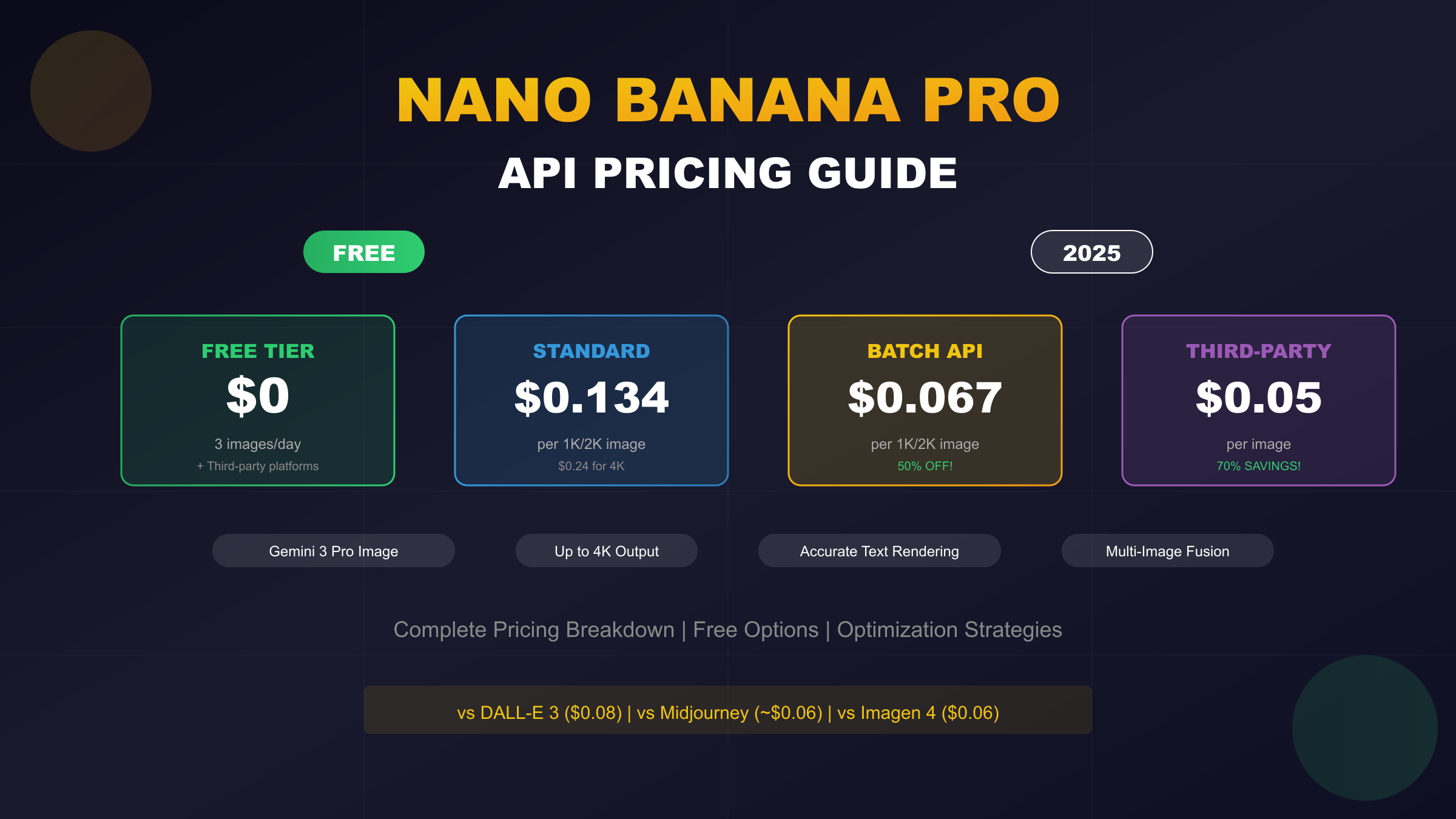
Free Tier Access: Every Way to Use Nano Banana Pro Without Paying
Before examining paid pricing, understanding free access options matters significantly—many users can accomplish substantial work without spending anything. Google provides several legitimate free pathways, and third-party platforms extend these options further.
Official Google Free Access
The most straightforward free access comes through the Gemini app at gemini.google.com. Free-tier users receive approximately three image generations daily at 1 megapixel resolution (roughly 1024×1024 pixels). While this resolution falls short of the 4K capability that distinguishes Nano Banana Pro, it provides sufficient quality for concept testing, social media content, and personal projects where maximum resolution isn't critical.
Beyond the strict three-image daily limit, many users report receiving between 50-100 total Nano Banana Pro generations before the system throttles them back to the older Gemini 2.5 Flash Image model. Mobile app users consistently report higher quotas than desktop users, and alternating between personal and Google Workspace accounts can effectively reset these soft limits. The system applies a visible Gemini watermark plus invisible SynthID digital signatures to all free-tier outputs, a consideration for commercial applications.
Google Cloud Platform offers new users $300 in free credits applicable to Gemini API usage, including Nano Banana Pro. This credit covers substantial testing—at $0.134 per standard-resolution image, $300 enables approximately 2,240 generations. Accessing this requires adding a valid payment method, though no charges occur until credits exhaust. The credits expire after 90 days, making them ideal for intensive evaluation periods rather than gradual long-term use.
Google AI Studio (aistudio.google.com) provides up to 1,500 daily API requests for development and prototyping. While intended for testing rather than production, this generous allowance supports extensive experimentation. Developers can generate API keys without payment, though production deployment requires billing activation.
Third-Party Free Platforms
Several platforms provide free Nano Banana Pro access beyond Google's direct offerings. These services typically operate through various arrangements—promotional periods, rate-limited access, or community-supported infrastructure.
| Platform | Daily Limit | Registration | Resolution | Notable Features |
|---|---|---|---|---|
| felo.ai | Near-unlimited | None required | Up to 4K | Fastest inference, no login |
| nano-banana.ai | 100-200 images | All supported | Clean interface, aspect ratios | |
| nanobanana-pro.com | ~500 images | None | Up to 4K | Multi-reference support |
| Lovart.ai | Varies (promotional) | Yes | Full features | Periodic "Banana-On-Us" events |
| LMArena | Daily limits | None | Standard | Side-by-side model comparison |
| Higgsfield AI | Unlimited | Twitter account | Varies | Tag @higgsfield_ai with prompt |
The catch with third-party free services involves reliability and longevity. Community-funded proxies may disappear without notice, rate limits can change abruptly, and service quality varies. Maintaining awareness of multiple platforms ensures backup options when primary services experience disruptions. For more details on free access methods, see our Gemini 3 Pro free API guide.
Free Tier Limitations and Considerations
Free access comes with practical constraints beyond simple image counts. Rate limits typically restrict requests to 1-5 per minute, making bulk generation impractical. Safety filters on free tiers tend toward aggressive blocking, rejecting prompts that paid tiers might process. All free outputs carry watermarks—visible sparkles from Gemini plus invisible SynthID signatures—that persist even after editing, creating potential complications for commercial use.
Despite these limitations, free tiers serve legitimate purposes: learning the model's capabilities, testing prompt strategies, generating content for personal projects, and evaluating whether paid access justifies the investment. Many creators operate entirely within free quotas by spreading generation across platforms and optimizing prompts to minimize failed attempts.
Official API Pricing: Complete Breakdown
When free tiers prove insufficient, understanding official Google API pricing becomes essential. The pricing structure involves token-based calculations that translate to per-image costs varying by resolution.
Standard API Rates
Google prices Nano Banana Pro through Vertex AI and Google AI Studio using a token-based system where images consume "output tokens" during generation. The practical per-image costs break down clearly:
| Resolution | Tokens Used | Cost per Image | Cost per 100 |
|---|---|---|---|
| 1K/2K | 1,120 tokens | $0.134 | $13.40 |
| 4K | 2,000 tokens | $0.24 | $24.00 |
These rates apply to image output specifically. Text prompts incur separate charges: $2.00 per million input tokens for prompts and $12.00 per million tokens for the model's "thinking" output. In practice, text costs remain negligible compared to image generation costs—a typical prompt consumes perhaps 100 tokens ($0.0002), making the per-image rates the dominant cost factor.
Image input—uploading reference images for style transfer or editing—costs just $0.0011 per image regardless of resolution. This enables cost-effective workflows where users provide extensive visual context to guide generation.
Batch API: 50% Savings for Asynchronous Workloads
The Batch API transforms economics for workflows tolerating delayed results. By processing requests asynchronously with results delivered within 24 hours, Google offers a straight 50% discount:
| Resolution | Standard Rate | Batch Rate | Savings |
|---|---|---|---|
| 1K/2K | $0.134 | $0.067 | 50% |
| 4K | $0.24 | $0.12 | 50% |
Batch processing suits numerous use cases: overnight content generation for marketing teams, bulk product image creation for e-commerce, dataset generation for machine learning training, and any pipeline where immediate results aren't required. Batches accept up to 10,000 requests, enabling substantial automation.
The combination of batch processing with other optimizations can compound savings dramatically. Teams generating thousands of monthly images routinely reduce costs from standard rates by 60-80% through strategic batch utilization.
Understanding Token Economics
The token-based pricing creates some non-intuitive cost dynamics worth understanding. Resolution affects cost because higher resolutions consume more tokens—4K images require approximately 1.8x the tokens of 2K images despite producing 4x the pixels. This means 2K output provides superior value per pixel when maximum resolution isn't essential.
Additionally, image generation differs from text generation in billing. While text models charge separately for input and output tokens at different rates, image generation primarily bills on output tokens regardless of prompt length. A one-sentence prompt and a detailed multi-paragraph prompt generating identical images cost essentially the same—incentivizing detailed, precise prompting that reduces failed generation attempts.
Third-Party API Services: Better Value Options
Official Google pricing isn't the only option. Third-party platforms aggregate API access, often offering significant savings through volume arrangements, geographic advantages, or simplified billing.
Third-Party Platform Comparison
| Provider | Nano Banana Pro Cost | Standard Nano Banana | Key Advantages |
|---|---|---|---|
| nanobananaapi.ai | ~$0.12/image (1K-2K) | ~$0.02/image | 20% below Google, free credits |
| kie.ai | $0.12/image (1K-2K) | $0.025/image | Interactive playground |
| GlobalGPT | From $5.3/month | Included | Unlimited access plans |
Third-party services typically undercut Google's official pricing by 10-30% for standard access, with some offering subscription models providing even greater savings for consistent usage patterns. These platforms handle API key management, usage tracking, and often provide enhanced features like image galleries, prompt libraries, and batch processing interfaces.
For developers and teams requiring reliable access at scale, services like laozhang.ai specialize in providing stable API access with transparent per-image pricing around $0.05—representing 60-70% savings versus official rates. Such services prove particularly valuable for users in regions with limited direct Google API availability or those seeking simplified billing without Google Cloud complexity.
When Third-Party Makes Sense
Third-party API access makes economic sense under specific conditions. Users generating 100+ monthly images typically save enough to justify platform fees or switching overhead. Teams without existing Google Cloud infrastructure avoid the complexity of setting up billing, understanding quota systems, and managing API credentials across multiple projects.
However, third-party platforms introduce dependencies. Evaluate reliability history, data handling policies, and the provider's business model sustainability before committing production workflows. Premium features like 4K output, specific aspect ratios, or advanced editing capabilities may not be universally available.
Subscription Plans: When Fixed Pricing Makes Sense
Beyond pay-per-use API access, subscription models provide cost predictability—particularly valuable for users with consistent monthly generation needs.
Google Gemini Subscription Tiers
Google offers Nano Banana Pro access through Gemini Advanced subscriptions via Google One:
| Plan | Monthly Cost | Approximate Images | Key Features |
|---|---|---|---|
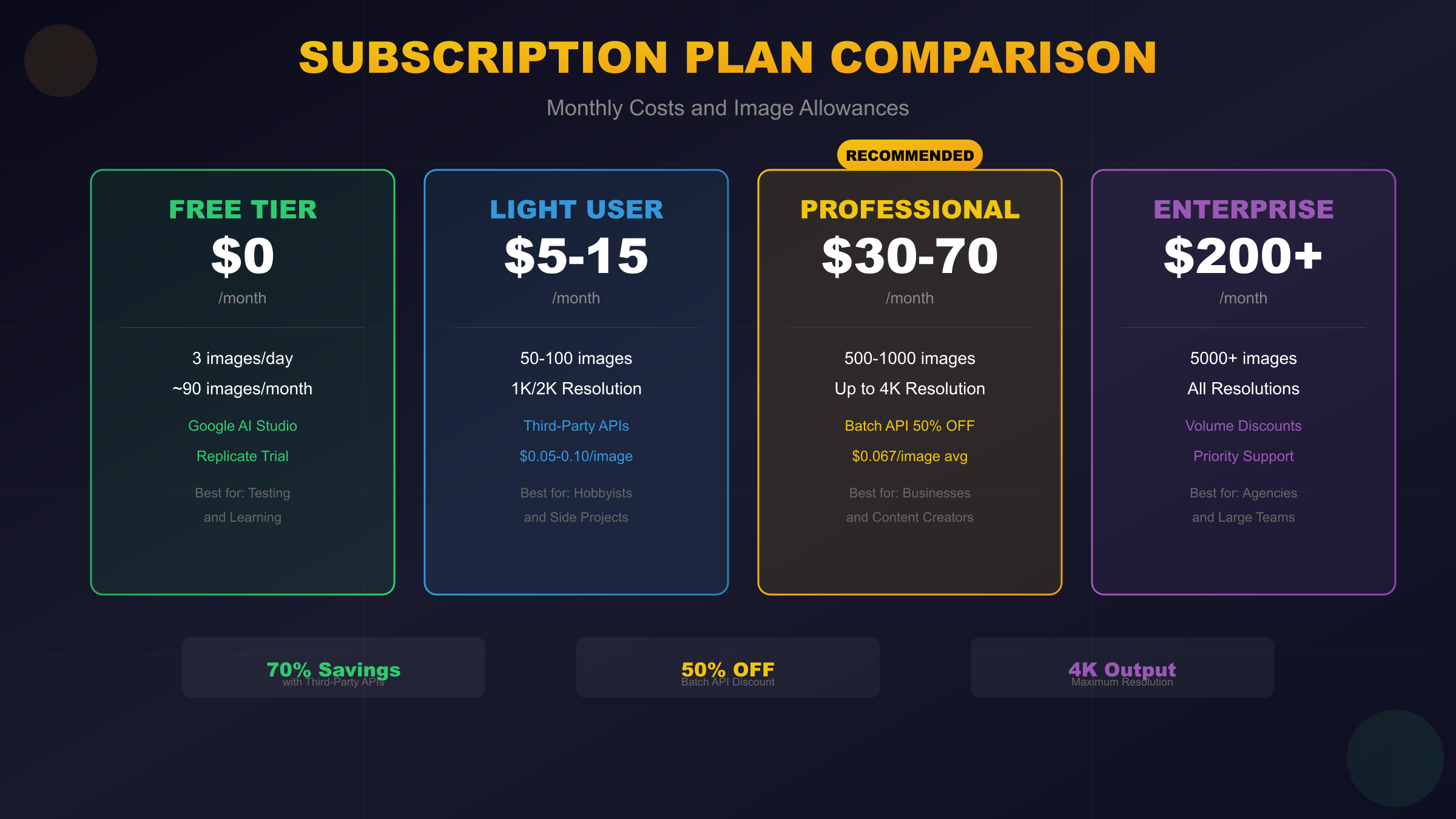
| Free | $0 | 3/day (1MP) | Basic access, watermarks |
| Gemini Pro | $19.99 | ~100-150 | Full 4K access, moderate limits |
| Gemini Ultra | $34.99 | Higher quotas | Priority access |
| Gemini Advanced | $124.99 | ~1,000+ | Hidden watermarks, highest priority |
Subscription pricing favors users with predictable, moderate volumes. At $19.99 monthly providing approximately 100 images, the effective per-image cost equals $0.20—more expensive than optimized API usage but simpler than managing API quotas, billing, and technical integration. For non-technical users primarily accessing through the Gemini app rather than building applications, subscriptions eliminate complexity.
nano-banana.ai Credit System
The nano-banana.ai platform offers an alternative credit-based subscription model:
| Plan | Monthly Price | Credits | Nano Banana Pro Images* |
|---|---|---|---|
| Basic | $9.99 | 100 | 6-12 images |
| Pro | $29.99 | 500 | 31-62 images |
| Max | $79.99 | 1,600 | 100-200 images |
*Based on 8-16 credits per Pro image depending on resolution
Annual subscriptions save 20%, and unused credits roll over. New users receive 5 free credits for testing. The credit system provides flexibility—users can generate more standard Nano Banana images (2 credits each) or fewer Pro images (8-16 credits each) depending on project needs.
Break-Even Analysis: Subscription vs API
Determining whether subscriptions save money requires comparing against realistic API usage:
At 50 images monthly using standard 1K/2K resolution:
- API cost: 50 × $0.134 = $6.70
- nano-banana.ai Basic: $9.99 (worse value)
- Gemini Pro: $19.99 (worse value)
At 200 images monthly:
- API cost: 200 × $0.134 = $26.80
- Batch API: 200 × $0.067 = $13.40
- nano-banana.ai Pro: $29.99 (worse than batch API)
At 500+ images monthly:
- API cost: 500 × $0.134 = $67
- Batch API: 500 × $0.067 = $33.50
- Third-party (laozhang.ai): 500 × $0.05 = $25
The analysis reveals that subscriptions rarely offer the lowest per-image cost for technically capable users willing to manage API access. Subscriptions excel for simplicity, not savings—ideal for users who value convenience over optimization or lack technical resources to implement API integrations.
Cost Calculator: Monthly Budget Scenarios
Translating per-image rates into monthly budgets requires realistic usage estimates. This section provides calculation templates and scenarios spanning casual creators to enterprise deployments.
Understanding Your Usage Pattern
Before calculating costs, estimate your monthly image volume. Track current generation patterns for a week, then multiply by four. Consider seasonal variations—marketing teams may see 3-5x normal volumes during campaign periods. Include failed generations in estimates; approximately 10-20% of prompts may require regeneration due to safety filters, quality issues, or prompt refinement.
The formula for monthly cost estimation follows a straightforward pattern:
Monthly Cost = (Images × Rate) + (Failed Generations × Rate × 0.15)
The failed generation buffer accounts for typical retry rates. More experienced users with optimized prompts see lower failure rates; new users should budget higher.
Light User Scenario: 50 Images Monthly
A freelance designer generating product mockups, social media graphics, and concept art might average 50 monthly images. At standard 1K/2K resolution:
| Access Method | Calculation | Monthly Cost |
|---|---|---|
| Standard API | 50 × $0.134 | $6.70 |
| Batch API | 50 × $0.067 | $3.35 |
| Third-party | 50 × $0.05 | $2.50 |
| Free platforms | 50 × $0 | $0* |
*Assuming adequate free tier quotas across platforms
For light users, free tier access across multiple platforms often suffices entirely. Even when exceeding free limits, costs remain negligible—under $10 monthly regardless of access method. Optimization matters little at this volume.
Medium User Scenario: 300 Images Monthly
A small marketing team producing regular campaign content, A/B testing creative variations, and maintaining social media presence might generate 300 monthly images. The economics shift:
| Access Method | Calculation | Monthly Cost |
|---|---|---|
| Standard API | 300 × $0.134 | $40.20 |
| Batch API | 300 × $0.067 | $20.10 |
| Third-party | 300 × $0.05 | $15.00 |
| Subscription (Gemini Pro) | Fixed | $19.99 |
At this volume, Batch API and third-party services provide meaningful savings over standard rates. The Gemini Pro subscription approaches cost-competitiveness for users who value simplicity. However, the subscription doesn't support API integration—only web interface access—limiting automation possibilities.
Heavy User Scenario: 1,000+ Images Monthly
E-commerce operations generating product variations, personalized marketing, and catalog imagery easily exceed 1,000 monthly images. Enterprise-scale budgeting becomes critical:
| Access Method | 1,000 Images | 2,500 Images | 5,000 Images |
|---|---|---|---|
| Standard API | $134 | $335 | $670 |
| Batch API | $67 | $167.50 | $335 |
| Third-party | $50 | $125 | $250 |
At scale, the difference between standard API and optimized third-party access compounds dramatically. A team generating 5,000 monthly images saves $420 monthly—over $5,000 annually—by using third-party services instead of standard API rates. This savings justifies significant investment in workflow optimization and provider evaluation.
4K Resolution Premium Calculation
Users requiring 4K output face approximately 80% higher costs. The premium calculation:
| Volume | 1K/2K Standard | 4K Standard | 4K Batch |
|---|---|---|---|
| 100 images | $13.40 | $24.00 | $12.00 |
| 500 images | $67.00 | $120.00 | $60.00 |
| 1,000 images | $134.00 | $240.00 | $120.00 |
The 4K batch rate ($0.12) actually undercuts standard 1K/2K rates ($0.134), making batch processing particularly attractive for high-resolution workflows. Teams that can tolerate 24-hour turnaround access premium resolution at discount pricing.
Cost Optimization Strategies
Beyond choosing access methods, specific strategies reduce Nano Banana Pro costs further. Implementing these approaches systematically compounds savings.
Strategy 1: Maximize Batch API Usage
The 50% batch discount represents the single largest optimization opportunity through official channels. Restructure workflows to batch requests overnight:
Content calendars allow advance planning—queue next week's social media images Friday evening for Monday morning delivery. Product catalogs benefit from batch processing entire collections rather than generating images individually. Training dataset generation for ML projects rarely requires real-time output.
Implementation requires minimal code changes. Replace synchronous API calls with batch endpoint submissions, then poll for completion or set up webhook notifications. Most SDK libraries support batch operations with straightforward configuration.
Strategy 2: Resolution Optimization
Many use cases don't genuinely require 4K output. Social media platforms compress and resize images regardless of source resolution. Thumbnail generation needs minimal pixels. A/B testing creative concepts benefits more from quantity than quality.
Audit final display contexts for your images. Web content typically renders at 72-96 DPI; mobile displays rarely exceed 2K effective resolution. Print applications may require 4K, but digital-only workflows often waste budget on unnecessary resolution. Using 1K/2K instead of 4K reduces per-image costs by 44%.
Strategy 3: Prompt Engineering for Fewer Retries
Poorly crafted prompts generate disappointing results requiring regeneration. Each failed attempt costs the same as success. Investing time in prompt optimization reduces total generation costs by reducing iteration cycles.
Specific techniques improve first-attempt success rates: include explicit style references ("in the style of product photography with white background"), specify negative constraints ("no text, no watermarks"), describe composition precisely ("centered subject, soft shadows, professional lighting"), and provide aspect ratio requirements upfront.
Testing prompts on free tiers before committing production budgets identifies problem patterns without cost. Build prompt libraries documenting successful formulations for repeated use.
Strategy 4: Strategic Platform Mixing
Different platforms excel for different use cases. Optimize by routing requests appropriately:
High-volume bulk generation routes through batch API or third-party services at lowest per-image rates. Urgent, real-time needs use standard API despite premium pricing. Experimental and testing work consumes free tier quotas. Subscription access serves non-technical team members who won't use API integrations.
This hybrid approach captures the advantages of each access method while minimizing their individual limitations.
Strategy 5: Caching and Deduplication
Repeated requests for identical or similar images waste budget. Implement caching layers that store generated images and serve cached versions for repeated requests. Hash prompts to identify duplicates; return existing images instead of regenerating.
For variation-heavy workflows (generating multiple options from similar prompts), consider single high-resolution generation followed by programmatic variations (crops, color adjustments, text overlays) rather than multiple API calls.
Nano Banana Pro vs Competitors: Value Analysis
Understanding how Nano Banana Pro pricing compares to alternative image generation models informs purchasing decisions. Each model offers distinct capabilities affecting value beyond raw price.
Price Comparison Table
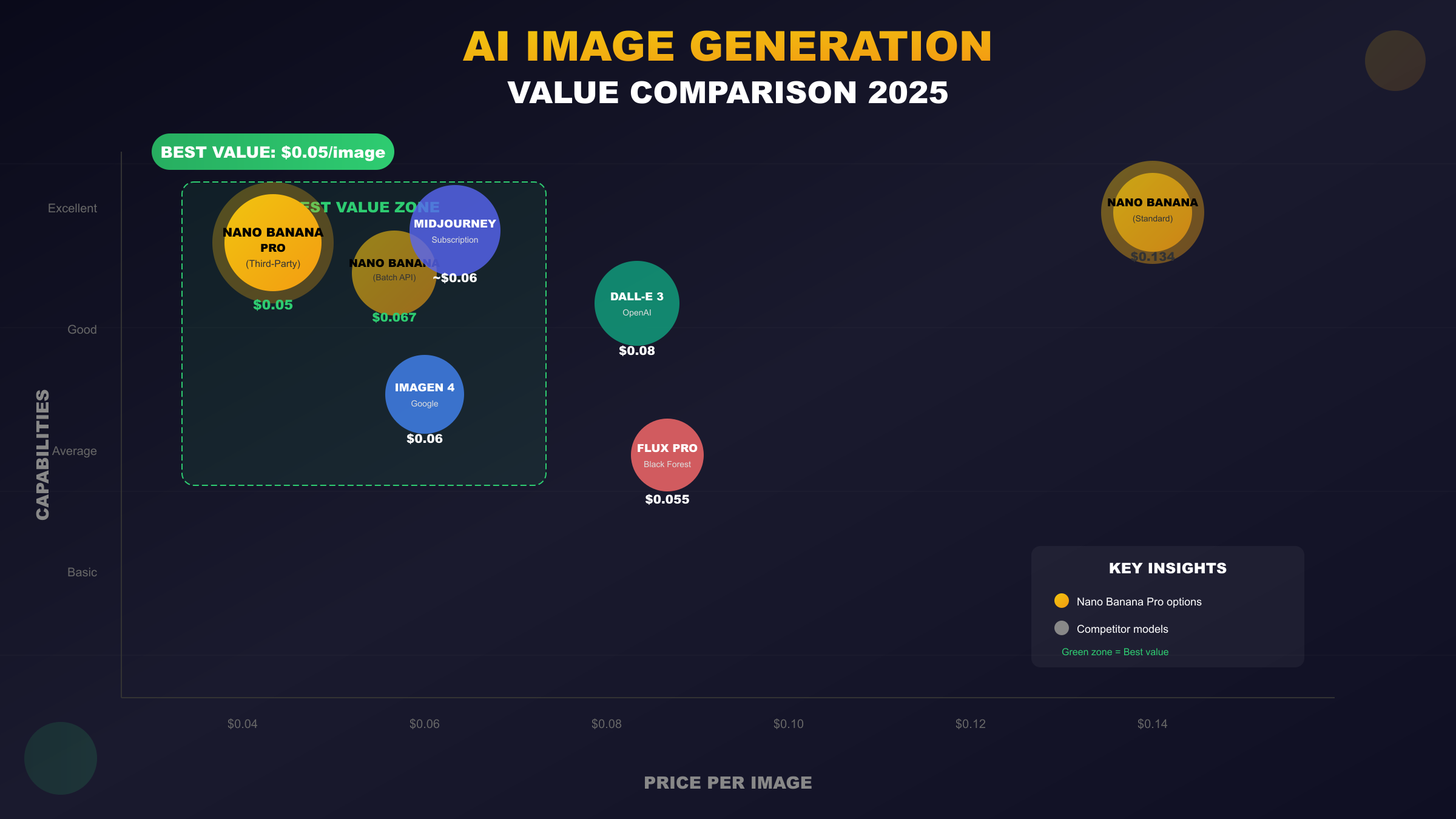
| Model | Per-Image Cost | Resolution | Text Accuracy | Unique Strengths |
|---|---|---|---|---|
| Nano Banana Pro | $0.134-0.24 | Up to 4K | ~94% | Best text rendering, multi-ref fusion |
| DALL-E 3 | $0.04-0.08 | 1024×1024 | ~70% | Wide availability, simple API |
| Midjourney | ~$0.06* | Up to 2K | ~71% | Artistic styles, community |
| Imagen 4 | $0.06 | Up to 4K | ~60% | Google integration |
| Flux Pro | $0.05-0.10 | Various | ~65% | Fast generation |
*Midjourney pricing varies by subscription tier; per-image estimate assumes moderate subscription usage.
Nano Banana Pro commands premium pricing—roughly 2-4x competitors at comparable resolution. This premium reflects specific capability advantages that justify cost for appropriate use cases.
When Nano Banana Pro Justifies Premium Pricing
Text rendering requirements: Nano Banana Pro's 94% text accuracy dramatically exceeds competitors. Marketing materials, social media graphics, UI mockups, and any image requiring embedded text benefit from this capability. Regenerating images with text errors costs more than the initial premium in many workflows.
Maximum resolution needs: At 4K output, Nano Banana Pro matches Imagen 4 while exceeding DALL-E 3 and most Midjourney outputs. Print production, high-resolution displays, and archival quality all benefit from native 4K generation.
Multi-image composition: The ability to merge up to eight reference images into coherent outputs enables workflows impossible with single-image models. Character consistency across marketing campaigns, style transfer from multiple references, and composite scene creation leverage this unique capability.
When Competitors Offer Better Value
Simple, high-volume generation: Teams needing thousands of basic images without text or resolution requirements save significantly with DALL-E 3 or Flux Pro. The 50-70% cost reduction at scale compounds quickly.
Artistic and creative exploration: Midjourney's community-trained models excel at artistic interpretation and creative styles. Subscription pricing favors exploration and iteration over precision.
Existing ecosystem integration: Organizations already embedded in OpenAI or specific cloud ecosystems may find friction-free integration worth modest price premiums over best-price options.
For users in regions with limited access to some providers, services offering alternative API access can bridge availability gaps while maintaining cost efficiency.
Making the Right Pricing Choice: Final Recommendations
After examining every Nano Banana Pro pricing option—from free tiers through official API rates to third-party alternatives—clear recommendations emerge for different user profiles.
For Hobbyists and Personal Projects
Start with free access exclusively. The Gemini app provides three daily images; third-party platforms like felo.ai and nano-banana.ai extend this significantly. Most personal projects can operate entirely without payment by rotating across free services and optimizing prompts to minimize wasted generations.
Only consider paid access after consistently exhausting free quotas. When that occurs, third-party services at $0.05 per image provide the most economical entry point—generating 100 images costs just $5, less than a single subscription month.
For Freelancers and Small Teams
Evaluate monthly volume realistically. Under 100 images monthly, standard API at $0.134 per image keeps costs under $15—simpler than managing third-party accounts. Between 100-500 monthly images, Batch API ($0.067) or third-party services ($0.05) provide meaningful savings worth the additional workflow complexity.
Avoid subscriptions unless you specifically need web-interface-only access for non-technical team members. Per-image API pricing almost always beats subscription economics for technically capable users.
For Enterprise and High-Volume Users
Build infrastructure around third-party API services and batch processing from day one. The difference between $0.134 standard API and $0.05 third-party access means saving over $400 per thousand images. At enterprise volumes, this compounds to five-figure annual savings.
Implement comprehensive optimization: batch processing for all non-urgent workloads, resolution optimization limiting 4K to genuine requirements, prompt libraries reducing iteration cycles, and caching eliminating duplicate generations. Each optimization layer compounds on others.
Services like laozhang.ai provide enterprise-appropriate reliability with transparent per-image billing, avoiding the complexity of Google Cloud quota management and billing while offering substantial cost advantages.
Getting Started Today
Begin exploring Nano Banana Pro through free channels immediately. Visit gemini.google.com to test the model's capabilities with your actual use cases. Evaluate output quality, understand the safety filter limitations, and develop effective prompting strategies—all without cost.
When ready to scale beyond free tiers, implement Batch API access through Google AI Studio for official-channel usage, or evaluate third-party providers for maximum cost efficiency. The technical integration overhead is minimal; most developers implement basic API calling within hours.
The Nano Banana Pro API pricing landscape offers genuine flexibility—from zero-cost exploration through enterprise-scale deployment. Understanding these options enables informed decisions matching capabilities to budgets, ensuring you access this remarkable image generation technology at appropriate cost for your specific needs.